

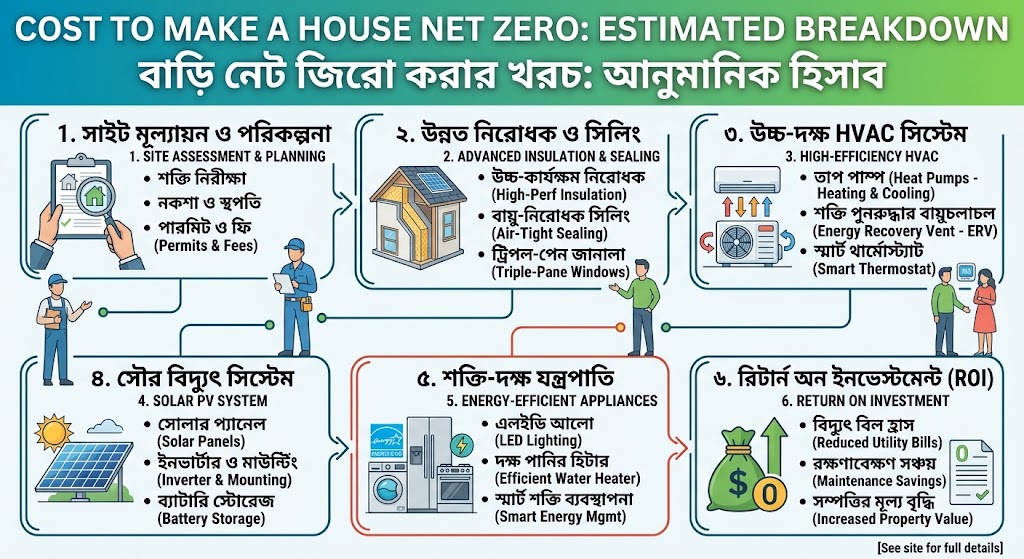
The direct answer: the cost to make a house net-zero typically runs between 100,000 and 200,000 dollars for an existing home renovation, or roughly 5 to 15 percent above standard construction cost, often expressed as a premium of about 10 dollars per square foot, when building net-zero from scratch. That range moves considerably based on home size, climate zone, and how much of the work involves retrofitting an existing structure versus building new performance directly into a fresh design. Understanding where that money actually goes, and which path costs less for your specific situation, is the difference between a realistic budget and an unpleasant surprise partway through the project.
This figure also changed meaningfully heading into 2026. The federal tax credits that previously covered 30 percent of qualifying insulation, heat pump, and solar costs expired for property placed in service after December 31, 2025, meaning the cost to make a house net-zero today reflects the full, un-subsidized price of every component, with state and utility rebates now filling only part of the gap that credit once covered. That shift makes an accurate, current cost breakdown more valuable than ever for anyone budgeting a genuine net-zero project this year.
This guide walks through the complete cost to make a house net-zero — the quick-answer figures by home size for both new construction and existing renovation, a direct comparison between building new versus retrofitting, the specific cost drivers that push a project higher or lower, and practical ways to bring the total down without compromising the end result.
What Does It Cost to Make a House Net-Zero?
The cost to make a house net-zero ranges from roughly 100,000 to 200,000 dollars for a full existing-home renovation, or an added 5 to 15 percent, commonly cited as approximately 10 dollars per square foot, when building net-zero performance directly into new construction.
Renovating an existing home to net-zero standard generally costs more per square foot of improvement than building net-zero from the ground up, since retrofitting insulation, air sealing, and mechanical systems into a structure not originally designed for them requires considerably more labor than integrating the same performance into a new build from day one. The final figure depends heavily on home size, starting condition, regional labor costs, and how much of the work involves envelope upgrades versus mechanical and solar equipment.
1. Cost by Home Size: New Construction
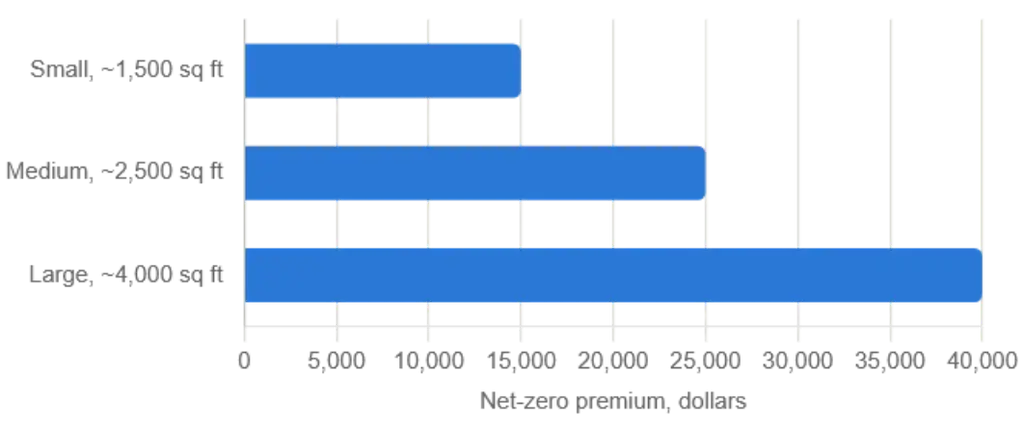
For homeowners building new rather than renovating, the cost to make a house net-zero scales fairly predictably with square footage once a per-square-foot premium is established. Real-world net-zero new-build costs run roughly 291 to 425 dollars per square foot in higher-cost regions like the Pacific Northwest before permitting, engineering, and design fees, while broader national data suggests the net-zero premium over comparable conventional new construction averages closer to 10 dollars per square foot, or 5 to 15 percent of total project cost.
Applying that premium across common home sizes gives a useful planning benchmark. A smaller home around 1,500 square feet typically adds roughly 15,000 dollars in net-zero-specific premium on top of standard construction cost. A mid-size home around 2,500 square feet adds roughly 25,000 dollars. A larger home around 4,000 square feet adds roughly 40,000 dollars. These figures represent the incremental cost of reaching net-zero performance specifically, not the full construction budget, which varies enormously by region, finish level, and site conditions independent of the net-zero target itself.
2. Cost by Home Size: Existing Home Renovation
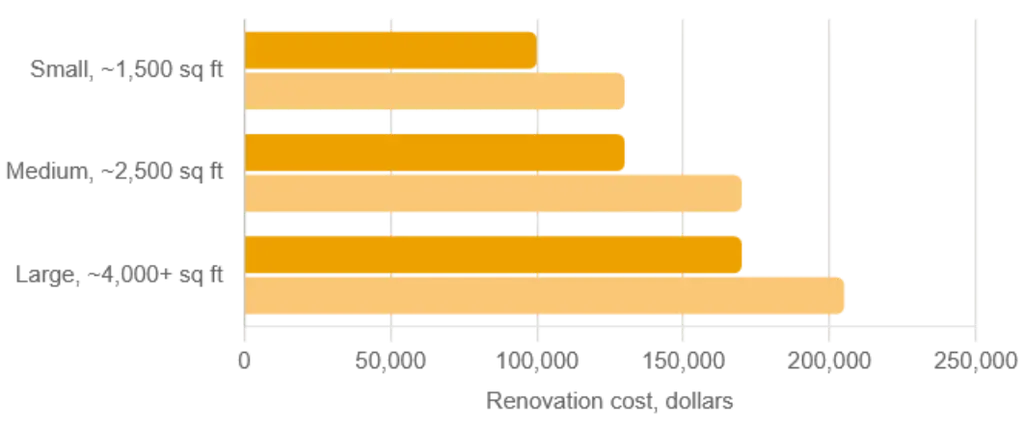
Retrofitting an existing home carries a meaningfully different cost structure within the broader cost to make a house net-zero picture, since every dollar spent must work around a structure not originally designed for high-performance construction. For a smaller existing home, roughly 1,500 square feet, a full net-zero renovation typically falls toward the lower end of the overall range, often 100,000 to 130,000 dollars depending on the home’s starting condition and climate zone.
A mid-size existing home around 2,500 square feet commonly lands in the 130,000 to 170,000 dollar range, while a larger existing home around 4,000 square feet or more can reach 170,000 to 200,000 dollars or beyond, particularly in regions with higher labor costs or more demanding climate requirements.
These renovation figures include the full scope typically required to reach genuine net-zero performance: building envelope work, air sealing, insulation, and often window replacement; mechanical system electrification, centered on a correctly sized heat pump and heat pump water heater; any necessary electrical panel or capacity upgrades; and a solar array sized to the home’s reduced, post-retrofit energy consumption. Homeowners targeting a lower-cost entry point, such as Zero Energy Ready performance that leaves the home solar-ready without installing panels immediately, can expect costs toward the lower half of these ranges, deferring the solar investment to a later phase.
It is worth emphasizing that these renovation figures assume a genuinely complete scope of work, not a partial upgrade that stops short of true net-zero performance. A homeowner who completes only envelope work and mechanical electrification, without adding solar, will spend considerably less than the full ranges shown here, but will also fall short of actual net-zero status, landing instead at the Zero Energy Ready or simply energy-efficient tier discussed elsewhere.
Understanding which specific outcome a given budget actually buys, rather than assuming any energy-related renovation automatically reaches net-zero, is essential to setting realistic expectations before construction begins.
3. New Construction vs Renovation: Which Costs Less?
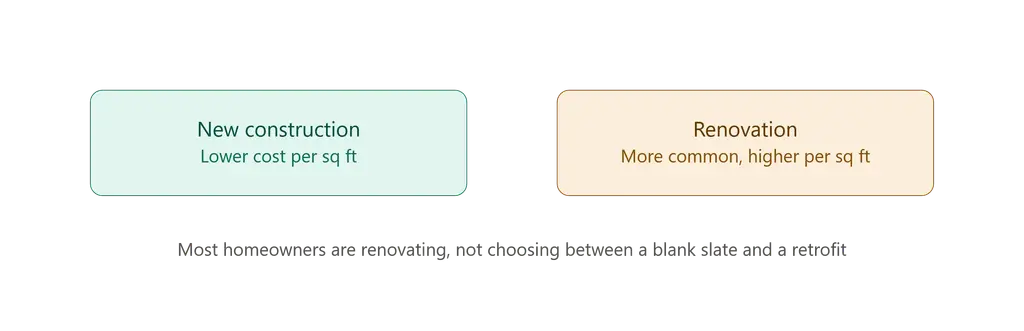
Comparing these two paths directly clarifies a genuinely important pattern within the cost to make a house net-zero conversation: building net-zero from scratch is consistently more cost-effective per square foot than retrofitting an existing home to the same standard. A new home can integrate continuous insulation, optimal window placement, and correctly sized mechanical systems from the first set of drawings, avoiding the labor-intensive work of opening existing walls, rerouting mechanical systems around an established structure, and working around whatever inefundamental compromises the original construction already baked in.
That said, the comparison is not simply new construction winning outright, since most homeowners considering net-zero already own an existing house and are not choosing between building new and renovating from a blank slate. For that far more common situation, comparing renovation costs to the value of staying in a known home, neighborhood, and school district, and to the resale value premium of 15 to 25 percent that verified net-zero performance commands, often justifies the renovation premium even though it costs more per square foot than a hypothetical new build would.
There is also a practical timing consideration that pure cost comparisons miss. A homeowner who needs to replace an aging furnace or roof anyway can fold net-zero-relevant upgrades into work that would happen regardless, meaningfully lowering the effective incremental cost of reaching net-zero performance compared to a homeowner starting entirely from scratch on a home with no planned near-term replacements. Factoring in this kind of bundled timing, rather than evaluating the cost to make a house net-zero as an entirely separate, standalone project, often reveals a more favorable true cost than the headline renovation figures suggest on their own.
4. What Drives the Total Cost Higher or Lower
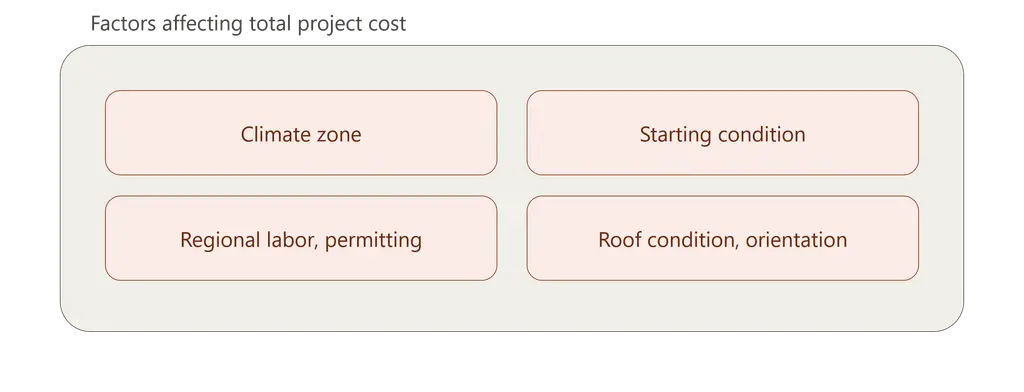
Several specific factors push the cost to make a house net-zero meaningfully above or below the typical range, beyond simple square footage. Climate zone plays an outsized role: colder climates require thicker insulation assemblies, higher-performance windows, and cold-climate-rated heat pumps, all of which add cost compared to a similar project in a milder climate. Starting condition matters just as much: a home with reasonably modern insulation and a newer roof will cost considerably less to bring to net-zero than one with original 1960s wall cavities and knob-and-tube wiring still in place.
Regional labor and permitting costs create their own significant swing, with documented differentials of up to 49 percent between the least and most expensive metro markets in the United States. Roof condition and orientation affect solar costs specifically, since a roof with poor southern exposure or heavy shading may require a larger, more expensive array or structural work to support panels effectively. Finally, the choice between a full net-zero target now versus a phased Zero Energy Ready approach that defers solar to a later date can shift the immediate cash outlay substantially, even though the eventual total cost converges toward a similar figure.
Home age interacts with several of these factors simultaneously rather than acting as an isolated variable. An older home in a cold climate with an outdated electrical panel compounds several cost drivers at once: it needs more aggressive envelope work to reach a given performance target, its existing wiring may already require replacement independent of the heat pump installation, and its windows are more likely to need full replacement rather than targeted repair. Homeowners evaluating the cost to make a house net-zero for a specific property should weigh these compounding factors together rather than assuming a single average figure applies evenly across every home type and vintage.
5. Practical Ways to Reduce the Cost
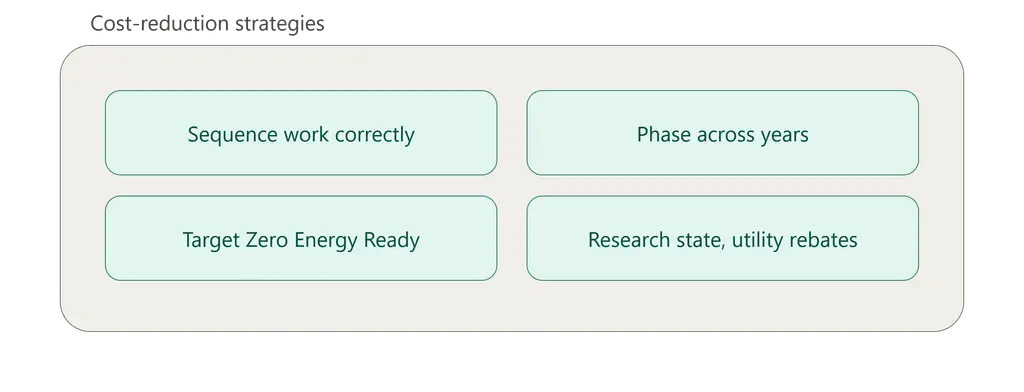
Homeowners can meaningfully influence the cost to make a house net-zero through a handful of genuinely effective strategies rather than simply accepting the highest quoted figure. Sequencing work correctly, addressing envelope improvements before mechanical replacement and mechanical replacement before solar sizing, prevents the single most expensive and common mistake in net-zero projects: paying for oversized equipment sized to the home’s original, leakier condition rather than its improved, post-retrofit performance.
Phasing the project across multiple years, rather than completing every component at once, spreads cost over time and lets homeowners capture whatever state and utility rebates remain available at each stage, since program funding and eligibility can shift from year to year. Targeting Zero Energy Ready performance rather than full net-zero immediately defers the solar investment specifically, often the single largest line item, to a point when budget allows, while still capturing the majority of the comfort and efficiency benefits today.
Finally, researching state and utility rebate programs specific to your location before finalizing a budget is no longer optional advice; with the federal 25C and 25D credits expired after 2025, these state-level programs represent the primary remaining source of financial support, and their generosity varies considerably by state.
Getting multiple contractor bids specifically for the Manual J load calculation and energy modeling steps, rather than accepting a single installer’s square-footage estimate, is another underused way to control the cost to make a house net-zero. A properly sized system based on genuine engineering analysis routinely costs less upfront than an oversized system chosen without that analysis, since correct sizing avoids paying for capacity the home will never actually use.
Combining that sizing discipline with careful sequencing, phased timing, and diligent rebate research gives homeowners genuine control over where their specific project lands within the broader cost ranges outlined here, rather than leaving the final number entirely to chance.
Key Facts: Cost to Make a House Net-Zero at a Glance
| Scenario | Typical Cost |
| New construction premium (small, ~1,500 sq ft) | Approximately $15,000 |
| New construction premium (medium, ~2,500 sq ft) | Approximately $25,000 |
| New construction premium (large, ~4,000 sq ft) | Approximately $40,000 |
| Existing renovation (small, ~1,500 sq ft) | $100,000 to $130,000 |
| Existing renovation (medium, ~2,500 sq ft) | $130,000 to $170,000 |
| Existing renovation (large, ~4,000 sq ft or more) | $170,000 to $200,000+ |
| Net-zero premium, new build, percent of total | 5 to 15 percent |
| Regional cost differential (US metros) | Up to 49 percent |
| Federal 25C/25D tax credits | Expired after Dec 31, 2025 |
| Resale value premium | 15 to 25 percent |
Frequently Asked Questions About the Cost to Make a House Net-Zero
How much does it cost to make a house net-zero?
The cost to make a house net-zero typically ranges from 100,000 to 200,000 dollars for an existing home renovation, or an added 5 to 15 percent, roughly 10 dollars per square foot, when building net-zero directly into new construction, with the exact figure depending on home size, climate, and starting condition.
Is it cheaper to cost to make a house net-zero new or renovate an existing one?
Building new is generally more cost-effective per square foot within the cost to make a house net-zero comparison, since performance can be integrated from the first drawings. Most homeowners, however, are renovating an existing home rather than choosing between the two, making renovation the more common and often more practical path despite its higher per-square-foot cost.
What is the biggest cost driver in making a house net-zero?
Building envelope work, insulation, air sealing, and windows, typically represents the largest single cost category in the cost to make a house net-zero, though climate zone, regional labor rates, and starting home condition also significantly influence the final total.
Can I make my house net-zero in phases to reduce upfront cost?
Yes. Targeting Zero Energy Ready performance first, which leaves a home solar-ready without installing panels immediately, is a common strategy to reduce the immediate cost to make a house net-zero, deferring the typically largest expense, solar, to a later budget cycle.
Do tax credits still reduce the cost to make a house net-zero in 2026?
The federal 25C and 25D tax credits, which previously covered 30 percent of qualifying costs, expired for property placed in service after December 31, 2025. The cost to make a house net-zero in 2026 depends more heavily on state and utility rebate programs, which vary considerably by location.
Does making a house net-zero pay for itself?
The cost to make a house net-zero is generally recouped within 10 to 15 years through eliminated or dramatically reduced utility bills, combined with a documented resale value increase of 15 to 25 percent for homes with verified net-zero performance.
Related Posts from Architecture Associate
- Net-Zero Home Renovation: Complete Guide to Costs & ROI
- Net-Zero Home Renovation Cost Breakdown by State
- Net-Zero Home Renovation Checklist for Homeowners
- Net-Zero vs Energy-Efficient Homes: What’s the Difference
Explore more sustainable design and renovation budgeting guides in the Architecture category on Architecture Associate.
External References
- Ask Doss, Best Energy Efficiency Upgrades 2026, Cost and Real Payback: askdoss.com
- Reno Quotes, Net-Zero Renovation Cost, Rebates and ROI Guide: renoquotes.com
- Zero Energy Project, Zero Energy Retrofits for Builders: zeroenergyproject.com
Final Thoughts
The cost to make a house net-zero is genuinely knowable once you separate the two very different paths available: an added 5 to 15 percent premium when building new, or a more substantial 100,000 to 200,000 dollar investment when retrofitting an existing home. Neither figure is arbitrary; both reflect real costs in building envelope work, mechanical electrification, and solar generation, scaled by home size, climate, and regional labor markets.
With the federal tax credit that once offset 30 percent of this cost now expired, getting the sequence right, envelope first, mechanical second, solar last, matters more than ever for keeping the total anywhere near the lower end of these ranges rather than the higher end.