

Choosing among solar panel systems for net-zero renovations means solving three separate equipment decisions at once: which panel technology fits a specific roof, which inverter architecture matches that roof’s shading and orientation, and whether battery storage genuinely earns its cost on that particular home. Getting any one of these three choices wrong does not necessarily prevent a home from reaching net-zero performance, but it routinely means paying more than necessary or leaving usable roof capacity unclaimed, both genuinely common mistakes on renovation projects where roof space is often more constrained than on new construction.
That constraint is precisely why panel efficiency matters more on a retrofit than it might on a ground-up build. A homeowner converting an existing home to net-zero energy is typically working with whatever roof area the original structure happens to offer, not a roof designed from scratch around solar capacity. In 2026, the best-performing solar panel systems for net-zero projects on tight or partially shaded roofs increasingly rely on high-efficiency N-type monocrystalline technology, including TOPCon and heterojunction cell architectures, precisely because higher efficiency per panel translates directly into fewer panels needed to hit a target system size on limited roof area.
This guide walks through the complete landscape of solar panel systems for net-zero renovations — the panel technologies worth considering and how they differ, the inverter architectures that determine how well a system handles a complicated renovated roof, when battery storage genuinely pays for itself, how to match a system to the specific constraints of a retrofit project, and the certifications and warranty details worth checking before signing a contract.
What Are the Best Solar Panel Systems for Net-Zero Home Renovations?
The best solar panel systems for net-zero home renovations generally combine high-efficiency N-type monocrystalline panels, an inverter architecture matched to the roof’s specific shading and orientation, and battery storage sized to the household’s actual outage risk and utility rate structure rather than added by default.
Monocrystalline panels using TOPCon or heterojunction cell technology now commonly achieve 22 to 24 percent efficiency, letting a renovated home reach its target solar capacity using fewer panels than older or lower-efficiency technology would require. String inverters remain the most cost-effective choice for simple, unshaded, single-direction roofs, while microinverters or power optimizers recover meaningfully more energy on the complex, multi-plane roofs common on renovated older homes with dormers, chimneys, or partial tree shading.
1. Panel Technology: Why Monocrystalline Leads for Retrofits

Among solar panel systems for net-zero renovations, monocrystalline silicon panels remain the default choice for the large majority of residential projects, and for retrofit work specifically, that default choice carries extra weight. Monocrystalline panels are the most efficient, longest-lasting, and most cost-effective panel technology broadly available, with top-tier panels now commonly reaching 22 percent efficiency or higher. That efficiency advantage matters disproportionately on a renovation, where the roof area available for solar was never designed around maximizing collection area the way a new-construction roof might be.
Within the monocrystalline category itself, two newer cell architectures have become increasingly relevant for net-zero retrofit projects. TOPCon, or Tunnel Oxide Passivated Contact, technology builds on standard monocrystalline silicon with an ultra-thin oxide layer that reduces energy losses, typically achieving 22 to 24 percent efficiency with notably better performance in high heat, a meaningful advantage for homes in hotter climates working to reach net-zero.
Heterojunction, or HJT, panels go a step further, combining crystalline silicon with thin-film amorphous silicon layers to deliver excellent temperature coefficients, very low degradation rates over time, and efficiency that can exceed 23 percent, at a premium price that many homeowners with genuinely limited roof space find worth paying for the additional yield.
2. Polycrystalline and Thin-Film: When They Still Make Sense
Not every home pursuing solar panel systems for net-zero performance needs the highest-efficiency panel available. Polycrystalline panels, built from multiple silicon crystals rather than a single crystal structure, remain less efficient than monocrystalline but considerably more affordable, and they handle heat reasonably well despite generally requiring more roof area to hit an equivalent system size. For a renovation with genuinely abundant, unshaded roof space and a tighter overall budget, polycrystalline panels can still deliver a functional path to net-zero performance without the price premium of top-tier monocrystalline technology.
Thin-film panels occupy a genuinely different niche within solar panel systems for net-zero projects. Lightweight, flexible, and capable of installation on curved or irregular surfaces that rigid panels cannot accommodate, thin-film technology suits specific retrofit scenarios, including properties in conservation areas requiring solar tiles rather than standard panels, or structures where roof geometry rules out conventional rigid panel mounting. That flexibility comes at a real cost, however: thin-film panels typically carry meaningfully lower efficiency and shorter service lifespans than crystalline alternatives, which is precisely why they remain a specialized choice rather than a mainstream one for most residential net-zero retrofits.
3. Inverter Architecture: Matching the System to the Roof

Panel selection matters, but inverter architecture is arguably the more consequential decision within solar panel systems for net-zero retrofits, since a roof’s specific geometry determines which inverter type actually delivers the most usable energy. String inverters, which tie all panels into a single circuit feeding one central DC-to-AC converter, remain the most cost-effective and reliable choice for simple, unshaded, single-direction roofs, where their simplicity and higher raw efficiency translate directly into lower system cost without sacrificing meaningful production.
Renovated older homes frequently present exactly the kind of complicated roof geometry where string inverters lose their advantage. A roof cut across multiple planes, facing several different directions, or partially shaded by a chimney, dormer, or nearby tree, causes a string inverter system to perform only as well as its weakest-producing panel, since all panels in a string share the same circuit.
Microinverters solve this directly by letting each panel operate independently, meaning a shadow falling on one corner of the roof no longer drags down the output of every other panel in the system, a genuinely significant advantage for the complex, multi-plane roofs common on renovated older housing stock. Power optimizers offer a middle path, retaining panel-level performance optimization while still routing through a single central inverter, often at a lower cost than full microinverters while still recovering much of the energy a string inverter would lose to shading.
4. Hybrid Inverters and the Battery Storage Question

For homeowners planning to add battery storage as part of their solar panel systems for net-zero renovation, hybrid inverters have become an increasingly common choice, functioning as a genuine three-in-one system that manages solar generation, battery charging and discharging, and backup power simultaneously. That consolidation matters for renovation projects specifically, since retrofitting a home with both solar and battery capacity using separate, uncoordinated inverter systems typically costs more and introduces more potential points of failure than a properly integrated hybrid system designed to handle both functions from the outset.
Whether battery storage belongs in a given net-zero renovation at all depends heavily on the household’s specific circumstances rather than a universal recommendation. Lithium iron phosphate, or LFP, battery chemistry now dominates residential storage, commonly rated for 6,000 to 10,000 charge cycles before dropping to 70 to 80 percent of original capacity, with round-trip efficiency in the 90 to 95 percent range.
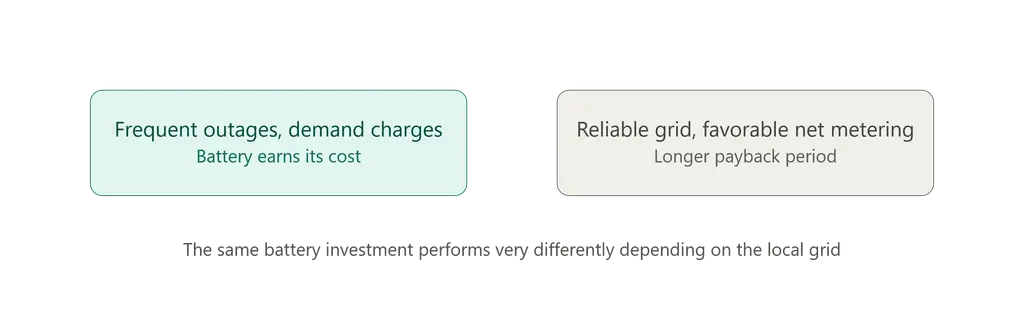
For homeowners in regions with frequent grid outages, unfavorable net metering policies, or utility rate structures that penalize peak demand, battery storage genuinely earns its cost within a solar panel systems for net-zero plan. For homeowners in regions with reliable grid service, favorable net metering, and flat rate structures, the same battery investment may deliver a considerably longer payback period, making it a reasonable component to defer or skip entirely.
5. Sizing Solar to a Retrofit’s Actual Post-Renovation Load
Every credible approach to solar panel systems for net-zero renovations depends on sizing the array to the home’s actual, post-retrofit energy consumption rather than its original, pre-renovation baseline. A home that has already completed envelope air sealing, insulation upgrades, and heat pump electrification carries a meaningfully smaller energy load than the same home before those upgrades, meaning the correctly sized solar array for a properly sequenced renovation is often smaller, and therefore less expensive, than a system sized to the home’s original consumption pattern.
This sizing logic connects directly to panel and inverter selection. A smaller, more precisely sized array on a constrained renovation roof benefits disproportionately from higher panel efficiency, since fewer, more productive panels are more likely to fit available roof area than a larger array of lower-efficiency panels chasing the same total wattage. Homeowners specifying solar panel systems for net-zero projects should request that their installer confirm system sizing against actual post-retrofit load calculations, not the home’s historical utility bills alone, since those historical bills reflect a building that, by the time solar goes in, should already perform meaningfully differently.
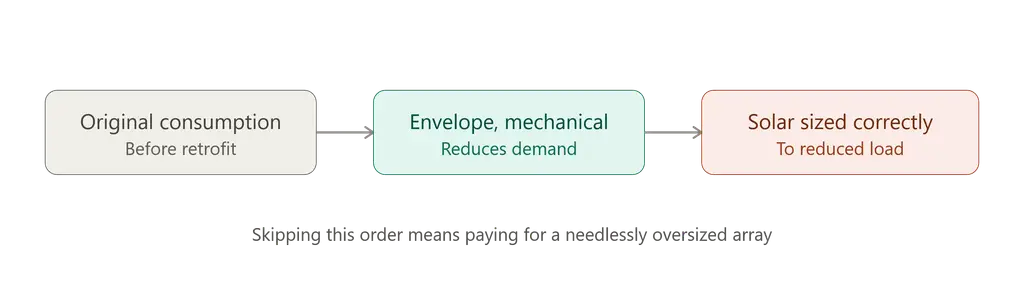
That sequencing discipline also protects homeowners from a common and expensive mistake: locking in a solar contract early in a renovation timeline, before envelope and mechanical work is complete, based on a system size calculated from the home’s pre-renovation energy bills.
Installers working from outdated consumption data will size a system correctly for a home that no longer exists once insulation, air sealing, and heat pump electrification are finished, and the resulting oversized array represents money spent on generation capacity the renovated home simply does not need. Coordinating the solar installer’s system design with the broader renovation timeline, rather than treating solar as an independent purchase decision, is what keeps this particular component of solar panel systems for net-zero projects genuinely cost-effective.
6. Certifications, Warranties, and What to Verify Before Signing
Beyond panel and inverter architecture, solar panel systems for net-zero projects should meet a specific set of technical and warranty benchmarks before a homeowner signs a contract. Systems should carry UL and IEC certification along with compliance to IEEE 1547-2018, the standard governing how inverters interact with the grid, including voltage and frequency ride-through capabilities increasingly required for utility interconnection and for participation in emerging grid service programs. Panel warranties in the 25 to 30 year range and inverter warranties spanning 10 to 25 years, depending on whether extended coverage is purchased, represent reasonable industry benchmarks worth confirming against any specific quote.
Real-world panel output also deserves scrutiny beyond the manufacturer’s headline efficiency figure. Panel performance always runs somewhat below the standard test condition rating used in marketing materials, and the California Energy Commission’s weighted efficiency figure, which averages inverter performance across a realistic range of load levels rather than reporting a single peak number, offers a more honest picture of expected annual production than a manufacturer’s best-case specification.
Homeowners comparing quotes for solar panel systems for net-zero renovations should ask installers directly for CEC-weighted efficiency figures and documented degradation rates, typically in the range of 0.2 to 0.5 percent annually for top-tier modules, rather than relying on peak efficiency numbers alone.
Key Facts: Solar Panel Systems for Net-Zero at a Glance
| Component | Detail |
| Standard monocrystalline efficiency | 20 to 24 percent |
| TOPCon panel efficiency | 22 to 24 percent, strong heat performance |
| HJT panel efficiency | Can exceed 23 percent, premium price |
| Best inverter for simple roofs | String inverter |
| Best inverter for complex roofs | Microinverter or power optimizer |
| Hybrid inverter function | Solar, battery, and backup in one unit |
| LFP battery cycle life | 6,000 to 10,000 cycles to 70-80% capacity |
| Battery round-trip efficiency | 90 to 95 percent |
| Typical panel degradation rate | 0.2 to 0.5 percent per year |
| Panel warranty range | 25 to 30 years |
| Inverter warranty range | 10 to 25 years |
| Key inverter code standard | IEEE 1547-2018 |
Frequently Asked Questions About Solar Panel Systems for Net-Zero Renovations
What are the best solar panel systems for net-zero home renovations?
The best solar panel systems for net-zero renovations combine high-efficiency N-type monocrystalline panels, often using TOPCon or heterojunction cell technology, with an inverter architecture matched to the roof’s shading and orientation, and battery storage sized to the household’s actual outage risk and utility rate structure.
Should I choose monocrystalline or polycrystalline panels for a net-zero retrofit?
Monocrystalline panels are generally the better choice for solar panel systems for net-zero retrofits, since their higher efficiency lets a renovation reach its target system size using fewer panels on typically constrained roof area, though polycrystalline panels remain a reasonable, more affordable option on homes with abundant, unshaded roof space.
When should I choose microinverters over a string inverter?
Microinverters outperform string inverters within solar panel systems for net-zero renovations specifically on complex, multi-plane roofs or roofs with partial shading from trees, chimneys, or dormers, since each panel operates independently rather than sharing a single circuit that underperforms to match its weakest panel.
Do I need battery storage for a net-zero home renovation?
Battery storage is not universally required within solar panel systems for net-zero projects. It earns its cost most clearly in regions with frequent grid outages, unfavorable net metering, or utility demand-charge rate structures, while homeowners with reliable grid service and favorable net metering may see a longer payback period from the same investment.
How should solar be sized for a net-zero home renovation?
Solar within a solar panel systems for net-zero plan should be sized to the home’s actual post-retrofit energy consumption, after envelope and mechanical upgrades have already reduced total demand, rather than sized to the home’s original, pre-renovation utility bills, which routinely results in an oversized and needlessly expensive array.
What certifications should I check before buying a solar system?
Homeowners evaluating solar panel systems for net-zero renovations should confirm UL and IEC certification, IEEE 1547-2018 inverter compliance, panel warranties in the 25 to 30 year range, inverter warranties of 10 to 25 years, and request CEC-weighted efficiency figures rather than relying on peak efficiency numbers alone.
Related Posts from Architecture Associate
- Net-Zero Home Renovation: Complete Guide to Costs & ROI
- How to Convert an Existing Home to Net-Zero Energy
- Net-Zero Home Renovation Cost Breakdown by State
- Basics of Light: 7 Bold Concepts Every Architect Needs
Explore more sustainable design and retrofit equipment guides in the Architecture category on Architecture Associate.
External References
- Solar Energy Simplified, Solar Panel Types Compared 2026: solarenergysimplified.com
- MySolarfy, Best Solar Inverters 2026: mysolarfy.com
- Digital Windmill, Best Solar Energy Systems 2026 Guide: digitalwindmill.com
Final Thoughts
There is no single best answer among solar panel systems for net-zero home renovations, only the combination of panel technology, inverter architecture, and battery storage genuinely matched to a specific roof, climate, and utility rate structure. High-efficiency monocrystalline panels earn their premium on the constrained, often-shaded roofs typical of renovated older homes, microinverters and power optimizers recover energy that string inverters lose on complex roof geometry, and battery storage pays for itself in some markets while representing an unnecessary expense in others.
Sizing every component to the home’s actual post-retrofit load, rather than its original consumption pattern or the largest array a roof could theoretically hold, remains the single decision that determines whether a net-zero renovation’s solar investment is genuinely well spent.
Solar panels are more than just shiny things on rooftops—they’re a big part of the puzzle when it comes to hitting that net zero target by 2025. We’ve talked about how they’re getting better and more efficient, which is awesome because it means more clean energy with less hassle. But it’s not just about the tech.
It’s about making solar power accessible to everyone, from big cities to remote villages. Sure, there are challenges, like the cost and the need for skilled folks to install and maintain them. But if we keep pushing, keep innovating, and keep working together, solar panels can help us cut down on carbon emissions and make the world a cleaner, greener place. So, let’s keep our eyes on the prize and make it happen.