

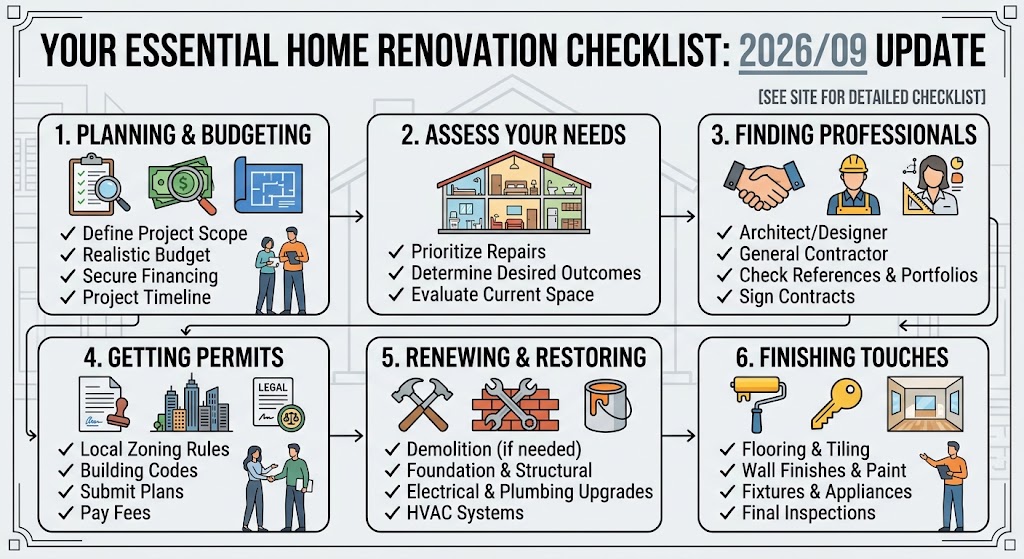
A net-zero home renovation checklist is only useful if it reflects the correct sequence, not just a list of tasks in whatever order feels intuitive. Homeowners who tackle a net-zero project item by item, without respecting the underlying order, routinely end up with oversized mechanical equipment, an oversized solar array, and thousands of dollars in avoidable cost. The sequence that actually works follows a consistent logic across every credible framework: audit first, seal the building envelope second, electrify mechanical systems third, confirm electrical capacity fourth, size solar last, and verify the results at the very end.
This net-zero home renovation checklist consolidates that sequence into six practical phases a homeowner can actually follow, whether managing the project personally or coordinating a general contractor across multiple trades.
Each phase includes the specific tasks that phase should accomplish before moving to the next, along with the 2026-specific budget and incentive realities that shifted meaningfully after the federal 25C and 25D tax credits expired at the end of 2025. Treating this as a genuine checklist, completing each phase fully before starting the next, is what separates a net-zero renovation that actually reaches its target from one that quietly falls short despite a large budget.
This guide walks through the complete net-zero home renovation checklist — the pre-renovation audit and planning phase, building envelope work, mechanical electrification, electrical capacity verification, solar and battery sizing, final verification and documentation, plus a dedicated budget and incentive checklist and the most common mistakes homeowners should avoid.
What Should Be on a Net-Zero Home Renovation Checklist?
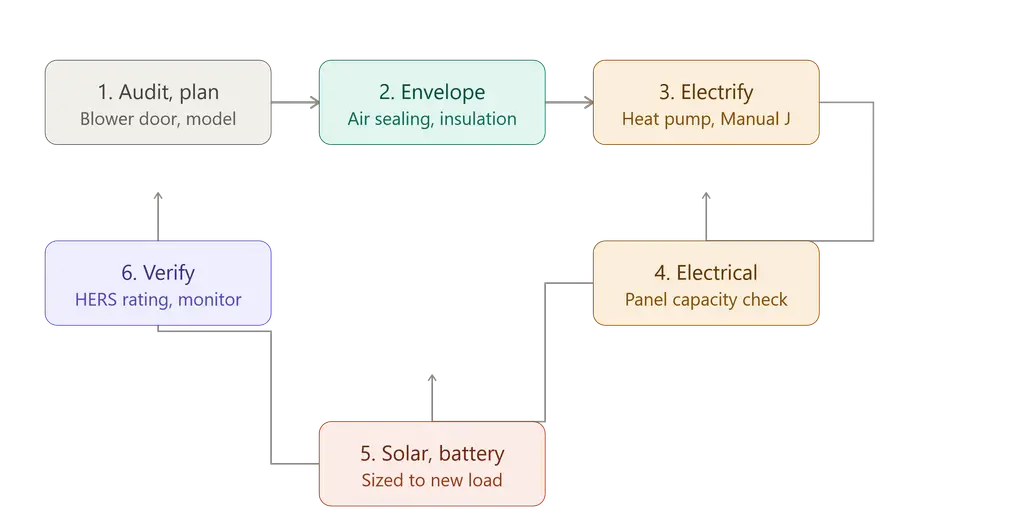
A complete net-zero home renovation checklist should cover six sequential phases: a comprehensive energy audit and modeling phase to establish baseline performance, building envelope work including air sealing and insulation, mechanical system electrification centered on a correctly sized heat pump, electrical panel and capacity verification, solar and battery sizing based on the home’s actual post-retrofit energy demand, and final verification through a blower door retest and HERS Index rating.
Each phase should be completed, and its results incorporated into planning, before the next phase begins, since skipping this order routinely results in oversized, needlessly expensive equipment at every subsequent stage.
Phase 1: Before You Start, Audit and Plan
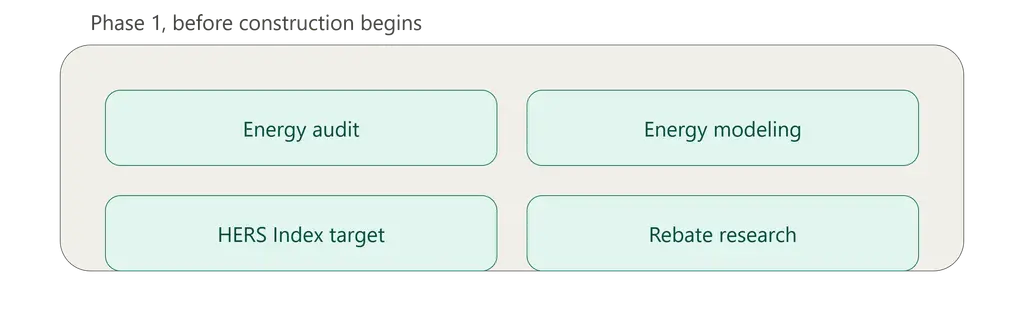
Every effective net-zero home renovation checklist begins with measurement, not construction. Before signing any contractor agreement, complete the following:
- Schedule a comprehensive energy audit including a blower door test, thermal imaging, and a review of at least one full year of utility bills
- Confirm the auditor is Building Performance Institute-certified or the assessment includes a RESNET-certified HERS rater
- Request an energy model that simulates different combinations of upgrades and attaches a cost estimate to each
- Establish your target HERS Index score, keeping in mind that a score of 0 represents true net-zero performance
- Decide whether you are targeting full net-zero now or a Zero Energy Ready Home standard that leaves the home solar-ready for a later phase
- Research state and utility rebate programs specific to your location before finalizing a budget
That last item deserves particular emphasis within this net-zero home renovation checklist, since the incentive landscape shifted considerably heading into 2026. With the federal 25C and 25D credits expired for property placed in service after December 31, 2025, the financial case for your specific project now depends far more on state-level programs and utility rebates than it did in prior years, making early research a genuine budgeting necessity rather than a nice-to-have step.
Phase 2: Building Envelope Work Comes First
Once the audit and modeling phase is complete, this net-zero home renovation checklist moves to the building envelope, the single highest-return category of work in the entire project:
- Complete attic air sealing and insulation upgrades, typically the fastest-payback item in the entire renovation
- Seal rim joists and other common air leakage points identified during the blower door test
- Upgrade wall cavity insulation where accessible, prioritizing exterior walls facing prevailing winter winds
- Replace the worst-performing windows and doors first if a full replacement budget is not available
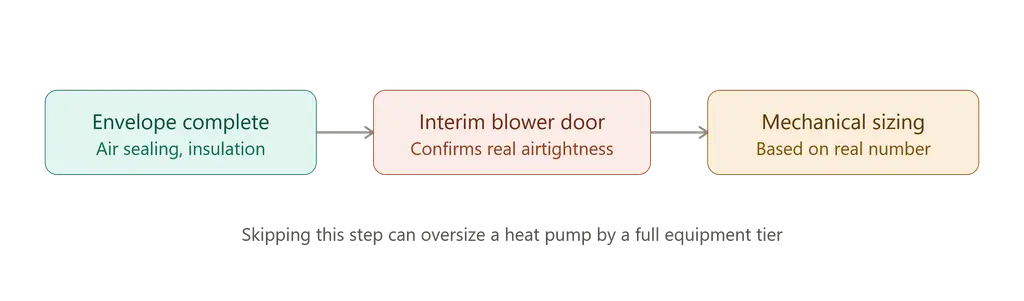
- Schedule an interim blower door test to confirm actual airtightness improvement before finalizing mechanical equipment sizing
That interim test matters more than it might initially seem. One of the most common and costly mistakes in real net-zero renovations is sizing mechanical equipment before the final airtightness number is actually known, a mismatch that can leave a heat pump oversized by a full equipment tier once the envelope work is genuinely finished. This net-zero home renovation checklist treats that interim verification step as mandatory, not optional, precisely to prevent that outcome.
Phase 3: Electrify Mechanical Systems
With the envelope tightened and verified, this net-zero home renovation checklist moves to mechanical electrification, the step where a home genuinely stops burning fossil fuels on site:
- Request a Manual J load calculation from your HVAC contractor, based on the home’s improved post-envelope condition, not its original baseline
- Confirm the calculation accounts for actual insulation levels, window performance, air leakage rate, and ductwork condition
- Select a heat pump system type matched to your home: ducted if existing ductwork is in good condition, ductless mini-split if not, or geothermal if long-term efficiency is the priority and budget allows
- For colder climates, verify the specific model’s cold-climate performance rating, coefficient of performance at low temperatures, and AHRI certification
- Replace gas or standard electric water heaters with a heat pump water heater
- Add a heat recovery ventilator if the home’s envelope has become substantially airtight, since natural infiltration can no longer be relied on for fresh air
Never accept a heat pump sized purely off square footage. Every credible net-zero home renovation checklist treats the Manual J calculation as a non-negotiable step, since installers who skip it are effectively guessing, and that guess routinely errs toward an oversized, inefficient system.
Phase 4: Verify Electrical Capacity
Electrifying mechanical systems adds real load to a home’s electrical service, making this step in the net-zero home renovation checklist a genuine prerequisite rather than an afterthought:
- Have a licensed electrician evaluate total planned electrical load across every electrification measure simultaneously, not just the heat pump alone
- Confirm whether your existing 100-amp or 200-amp panel can accommodate the new heat pump, typically drawing 15 to 30 amps
- Account for other planned electrification, including EV charging, induction cooking, and heat pump water heating, in the same capacity assessment
- Explore load management devices or a sub-panel addition as alternatives to a full service upgrade if capacity is tight
- Confirm any panel work is completed before mechanical equipment installation, not scheduled around it reactively
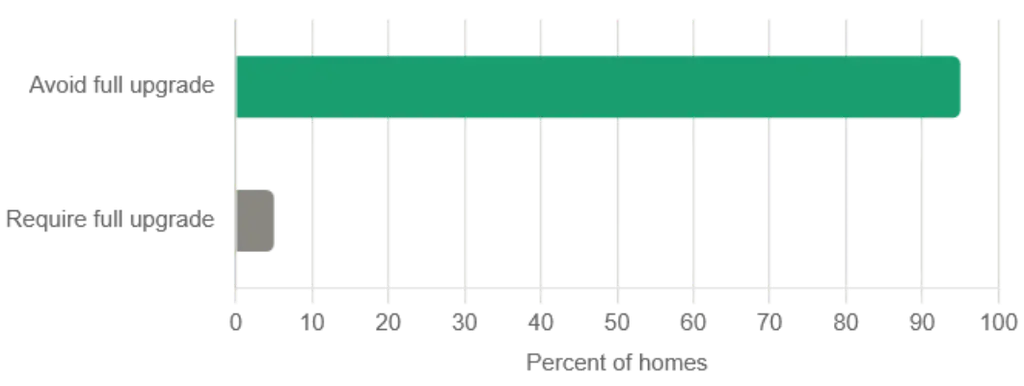
Roughly 95 percent of home retrofits do not require a full electrical panel upgrade when approached with this kind of coordinated planning, which is precisely why this net-zero home renovation checklist places electrical verification as a distinct, deliberate phase rather than leaving it to be discovered mid-installation.
Phase 5: Size and Install Solar and Battery Storage
Only after the previous four phases are complete should this net-zero home renovation checklist move to solar, the step most homeowners are tempted to prioritize first and should not:
- Request solar sizing based on your home’s actual, post-retrofit energy consumption, not its original pre-renovation utility bills
- Choose panel technology appropriate to your available roof area, favoring high-efficiency monocrystalline panels on constrained or partially shaded roofs
- Select an inverter architecture matched to your roof’s geometry: string inverters for simple, unshaded roofs, microinverters or power optimizers for complex or shaded roofs
- Evaluate whether battery storage genuinely earns its cost given your local grid reliability, net metering policy, and any utility demand-charge structure
- Confirm roof condition and any structural reinforcement needed before panel installation, not after
- Verify all equipment carries UL and IEC certification and complies with IEEE 1547-2018 for grid interconnection
Sizing solar correctly at this stage is where the entire sequence pays off. A net-zero home renovation checklist followed in order means the solar array only needs to offset the home’s genuinely reduced consumption, not its original, wasteful baseline, keeping this typically expensive final phase as affordable as the earlier phases allow it to be.
Phase 6: Verify and Document Performance
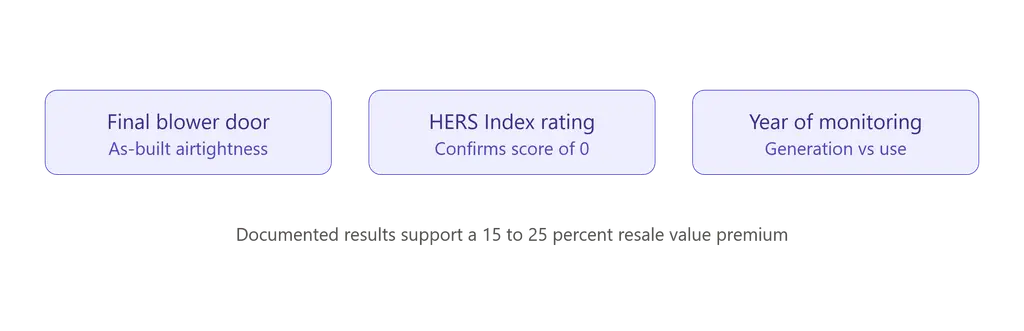
Completing installation is not the same as confirming net-zero performance, which is why this net-zero home renovation checklist ends with a dedicated verification phase:
- Schedule a final blower door test to confirm the envelope’s actual, as-built airtightness
- Obtain a final HERS Index rating from a certified rater, confirming whether the home has genuinely reached a score of 0
- Set up solar monitoring software to track generation against consumption in real time
- Monitor performance across at least one full year, since seasonal variation is the real test of whether the home balances its energy books annually
- Keep all audit reports, Manual J calculations, HERS ratings, and equipment certifications organized for future resale documentation
That documentation matters for reasons beyond personal satisfaction. Markets tracking deep energy retrofits show resale value increases in the range of 15 to 25 percent for homes with verified, documented net-zero performance, a premium that depends on having the paperwork to actually prove the claim to a future buyer or appraiser.
Budget and Incentive Checklist for 2026
Because the incentive landscape shifted meaningfully at the start of 2026, this net-zero home renovation checklist includes a dedicated budgeting section:
- Confirm the federal 25C and 25D tax credits do not apply to your project if placed in service after December 31, 2025
- Research your state’s HEAR and HOMES rebate program funding status, since rollout and generosity vary considerably by state
- Check your utility’s specific efficiency and solar incentive programs separately from state-level programs
- If building new or undertaking major renovation, ask your builder whether Zero Energy Ready or ENERGY STAR certification qualifies for the builder-facing Section 45L credit, which expires for homes acquired after June 30, 2026
- Request the AHRI certificate for any heat pump model to confirm rebate eligibility tied to that specific equipment pairing
- Budget realistically: a full net-zero renovation for an existing home typically runs 100,000 to 200,000 dollars depending on size, climate, and starting condition
Common Mistakes This Checklist Helps You Avoid
A handful of mistakes appear repeatedly in net-zero renovations that skip or reorder steps in this net-zero home renovation checklist:
- Sizing a heat pump or solar array off square footage or historical utility bills rather than a proper load calculation
- Installing solar before completing envelope and mechanical work, resulting in an oversized, needlessly expensive array
- Skipping the interim blower door test, leading to mechanical equipment sized for a leakier home than what actually gets built
- Assuming a full electrical panel upgrade is required without a coordinated load assessment across all planned electrification
- Failing to research state and utility rebates before finalizing a budget, given the loss of the uniform federal tax credit
Key Facts: Net-Zero Renovation Checklist at a Glance
| Phase | Key Task | Typical Outcome |
| 1. Audit and plan | Blower door test, energy modeling | Baseline HERS Index established |
| 2. Building envelope | Air sealing, insulation, windows | Reduced heating and cooling load |
| 3. Electrify mechanical | Manual J, heat pump, HRV | Correctly sized equipment |
| 4. Electrical capacity | Coordinated load assessment | Panel upgrade avoided in ~95% of homes |
| 5. Solar and battery | Sized to post-retrofit load | Smaller, more affordable array |
| 6. Verify and document | Blower door retest, HERS rating | HERS Index of 0 confirmed |
| Federal 25C/25D credits | N/A | Expired after Dec 31, 2025 |
| Full renovation cost range | N/A | $100,000 to $200,000 |
| Resale value premium | N/A | 15 to 25 percent |
Frequently Asked Questions About the Net-Zero Home Renovation Checklist
What is the first step in a net-zero home renovation checklist?
The first step in any net-zero home renovation checklist is a comprehensive energy audit, including a blower door test, thermal imaging, and utility bill review, which establishes the baseline every later decision in the renovation depends on.
Why does building envelope work come before mechanical systems on this checklist?
This net-zero home renovation checklist places envelope work second because air sealing and insulation directly reduce a home’s heating and cooling load, which determines the correct size for the heat pump installed in the following phase, preventing costly oversizing.
Should solar be the first or last item on a net-zero renovation checklist?
Solar belongs last on any properly sequenced net-zero home renovation checklist, since it should be sized to the home’s actual, reduced energy consumption after envelope and mechanical work are complete, not to its original, less efficient baseline.
How do I verify my home actually reached net-zero performance?
This net-zero home renovation checklist treats verification as a mandatory final phase, involving a final blower door retest, a certified HERS Index rating confirming a score of 0, and at least a full year of monitored solar generation against actual consumption.
What budget should I expect for a full net-zero renovation?
A full net-zero home renovation checklist typically corresponds to a project cost between 100,000 and 200,000 dollars for an existing single-family home, depending on size, climate zone, and starting condition, a figure that no longer includes the expired 30 percent federal tax credit.
Do I need a full electrical panel upgrade to complete this checklist?
Not usually. Roughly 95 percent of homes following a properly coordinated net-zero home renovation checklist avoid a full panel upgrade through strategic load assessment, load management devices, or a sub-panel addition rather than a complete electrical service replacement.
Related Posts from Architecture Associate
- How to Convert an Existing Home to Net-Zero Energy
- Heat Pump Installation Guide for Net-Zero Renovations
- Best Solar Panel Systems for Net-Zero Home Renovations
- Net-Zero Home Renovation: Complete Guide to Costs & ROI
Explore more sustainable design and renovation planning guides in the Architecture category on Architecture Associate.
External References
- Zero Energy Project, Zero Energy Retrofits for Builders: zeroenergyproject.com
- RESNET, HERS Raters: resnet.us
- Green Building Advisor, A Roadmap for Getting to Net-Zero: greenbuildingadvisor.com
Final Thoughts
This net-zero home renovation checklist works because it enforces a sequence, not just a task list. Audit before you build, seal the envelope before you electrify, electrify before you finalize electrical capacity, verify capacity before you size solar, and size solar before you install it, then document everything at the end.
Homeowners who follow every phase in order end up with correctly sized equipment, a smaller and more affordable solar array, and genuine, verifiable net-zero performance. Homeowners who skip ahead to the most visible or exciting phase, almost always solar, routinely pay for that shortcut later in oversized equipment and a longer, more expensive path to the same destination. The checklist is not bureaucratic caution; it is the actual reason a net-zero renovation succeeds.