



 “Space will only have a life when people enter it. So the important role architecture
can play, and that space plays within that architecture, is to encourage an
interaction between people, between people and the ideas being presented in the
paintings and sculpture, and most importantly between people themselves.”
The
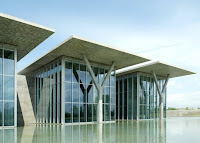
Modern Art Museum of Fort Worth exemplifies the work of Japanese architect
Tadao Ando through it’s simple geometry, incorporation of the natural environment,
and very minimal material selections. Five long, flat-roofed pavilions
appear to float atop the 1.5-acre reflecting pond, which is reminiscent of
other Ando projects.
Constructed with only concrete, steel, aluminum, glass and
granite, the museum is perfectly reflected in the surrounding pond. Beautiful
trees and hills enclose the museum, which is typical of Ando’s architecture.
Through its pure design, the museum has a striking presence as a modern work of
art. The environment becomes as beautiful as the artwork that the museum
displays, as it is heavily intertwined with the display spaces through large
windows. The glass and water are very complimentary, as the still pond reflects
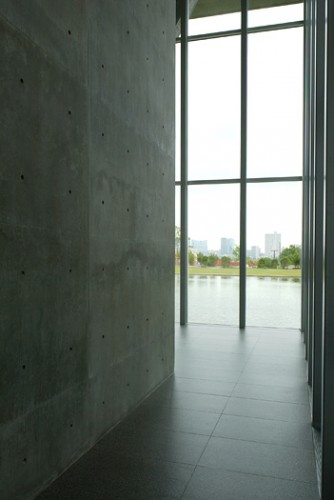
the spaces just as glass reflects the “By using glass as a wall, physically
there is a barrier, a protection from the outside, but visually there is no
boundary between outside and inside. There is also the light that comes off the
water through the glass that indicates a lack of boundary and can make its
presence felt on the wall.”water. The use of concrete indicates Ando’s passion
in planes and sharp, clean edges that the material allows. The massive planar
walls help tell of the building’s basic structure. Contrasted with the natural
environment that typically surrounds his architecture, the two elements become
even more dynamic.


The art museum of Fort Worth shows the finest degree of
emphasis on the boundary; using the materials to create architecture that seems
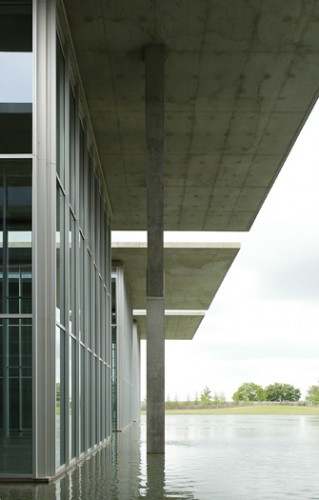
to float on the pond that surrounds it. Light also became key in
the design of the museum, with an emphasis on both diffused and reflected
natural light. Cantilevered cast-concrete roofs support linear skylights and
clerestory windows, which accomodate natural light. Five Y-shaped columns
standing 40 feet high support the roof slabs, and have become a symbol of the
museum.

 The museum is located near
Louis Kahn’s Kimbell Art museum, as well as the Amon Carter Museum by Philip
Johnson. It houses more that 2,600 significant works of modern and contemporary
international art in it’s 53,000 square feet of gallery space.