

 |
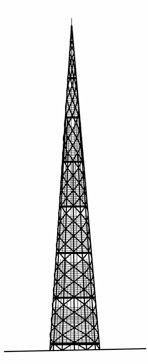
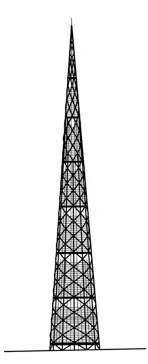
| Figure 2. Millennium Tower |
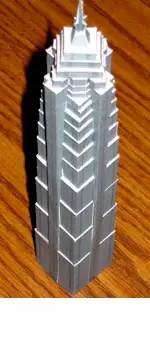 |
| Figure 3. Model of Jin Mao Building |
Phage 2
C) Tapering and Setbacks
Reducing
floor areas gradually toward the top is a good strategy to enhance
lateral performance of a building. This way, the mass of the building is
concentrated in the lower floors. More importantly, when hitting a
building using tapering and setbacks, the vortices will try to shed at
different
frequencies at different heights. In other
words, the winds become “confused” and incoherent, which can
dramatically reduce the associated fluctuating forces Examples of
“tapering” strategy are: John Hancock Center (Chicago), Millennium Tower
(Tokyo), and Transamerica Pyramid (San Francisco). The Jin Mao Building
(Shanghai) and the Petronas Tower (Kuala Lumpur) are good examples of
using “setbacks” to slightly taper the building shape.While “setback” is
rather tricky to apply to a Diagrid building because of the continuity
of the structure, “tapering” is highly suitable.
D) Sculptured Building Tops
The
sculptured building tops not only highlight the height of the
structure, but also serve the practical aerodynamic purposes such as
reduction in the wind response of the building. The more sculptured a
building’s top, the better it can the along wind and across wind
responses. Examples: Jin Mao Building, Petronas Towers, etc.
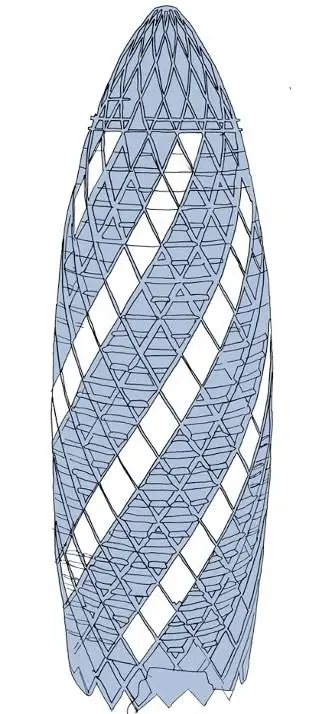 |
| Figure 4. 30 St Mary building uses “spoilers” to defect wind loads |
 |
| Figure 5. Shanghai World Financial Center |
E) Varying Cross-section Shape
Varying
cross-section shape with height, e.g. going from square to round, can
force the wind to behave differently, preventing in becoming
“organised”. This results in “confused” vortices, which is a similar
effect to using tapering and setback. Examples include Buji Khalifa
(Dubai) and the Sears
Tower (Chicago).
F) Rotated and Twisted Forms
Rotated
building forms can minimize loads from prevailing directions, while
twisted forms can avoid simultaneous vortex shedding along building’s
height.
G) “Spoilers”
Vortex shedding can
also be reduced by adding “spoilers” to the outside of the building. The
most well-known form of spoilers is the spiral Scruton strake which is
widely used on circular chimney stacks. It is very convenient to use
this strategy on Diagrid structures due to the geometry benefit of
the grid. Example: 30 St Mary building (London).
H) “Through-building” Openings
In
sustainable design of tall buildings, opening areas are fundamental.
This can be exploited to provide areas whichwind can blow all the way
through, thus reduce wind loads.
Diagrid, with its unique
structure characteristic, can provide random openings without affecting
the structure at all. Multiopenings is also a good strategy. Example:
Shanghai World Financial Center (Shanghai).