


The earliest meeting places were probably nothing more than conveniently situated open areas, their form dictated entirely by whatever the surrounding landscape happened to offer. There was no acoustic science guiding these gatherings, only trial and error: as the need arose to address larger groups for entertainment, ritual, or civic debate, it became clear that concentric circles brought the greatest number of people close to a central speaker. The history of acoustics effectively begins here, with people instinctively arranging themselves according to the directional nature of the human voice long before anyone had a formal theory to explain why some seats sounded better than others.
That instinctive beginning eventually matured into genuine architectural science. Because the human voice projects most strongly along its central axis and grows less intelligible as a listener moves off that axis, ancient seating arrangements developed naturally around this vocal polar pattern, favoring locations that captured the clearest, most direct sound.
By the fourth century BCE, Greek builders had turned that intuition into precise engineering, producing amphitheaters like the Theater of Epidaurus that could reportedly carry a performer’s unamplified voice to the back row of an audience numbering in the thousands. The history of acoustics from that point forward is a story of steadily replacing intuition with measurement, culminating in Wallace Sabine’s turn-of-the-twentieth-century experiments that finally gave architects a genuine predictive science to work from.
This guide walks through the complete story of the history of acoustics — the earliest instinctive seating arrangements shaped by the human voice, the precision engineering of Greek and Roman theaters, Vitruvius’s writings that carried ancient acoustic knowledge into later centuries, the long pre-scientific era before Sabine, Sabine’s foundational reverberation research, the twentieth-century expansion of acoustics into a genuine engineering discipline, and where computational acoustic design stands today.
What Is the History of Acoustics?

The history of acoustics traces how humans moved from instinctively arranging gathering spaces around the directional properties of the human voice to developing a genuine predictive science of how sound behaves inside built spaces. Early open-air meeting places gave way to precisely engineered Greek amphitheaters like the Theater of Epidaurus, built around 330 to 320 BCE and attributed to the architect Polykleitos the Younger, whose semicircular limestone seating could reportedly deliver clear, unamplified speech to audiences of up to fourteen thousand people.
Roman architect Vitruvius later documented much of this accumulated acoustic knowledge in his Ten Books on Architecture, but the field remained largely empirical until physicist Wallace Sabine’s research between 1895 and 1900 at Harvard’s Fogg Art Museum and Boston Symphony Hall established reverberation time as a measurable, predictable quantity, founding architectural acoustics as a genuine scientific discipline.
1. Instinctive Beginnings: Seating Shaped by the Human Voice

The history of acoustics did not begin with a scientist or a formula; it began with ordinary people seeking out the spots where they could actually hear a speaker clearly. The earliest meeting places were little more than conveniently situated open areas, their suitability to purpose largely haphazard, determined by whatever natural amphitheater-like slope or clearing happened to be available. As communities grew and the need to address larger crowds for entertainment, ritual, and civic debate increased, a pattern emerged organically: concentric, curved seating arrangements consistently brought the greatest number of listeners as close as possible to a central speaking position.
That pattern was not arbitrary. Because the human voice is inherently directional, projecting most clearly along its central axis, intelligibility drops noticeably as a listener moves off that axis to the side or behind a speaker. Early audiences, without any formal understanding of acoustics, gravitated toward seating positions that respected this vocal polar pattern, effectively encoding an unwritten acoustic principle directly into the built environment through nothing more than repeated trial and preference. This period represents the true starting point of the history of acoustics: acoustic design existed as lived practice long before it existed as documented theory.
2. Greek Theaters and the Engineering of Perfect Hearing

By the fourth century BCE, that instinctive practice had matured into remarkably precise engineering, marking one of the most significant chapters in the history of acoustics. The Theater of Epidaurus, built around 330 to 320 BCE under the direction of architect Polykleitos the Younger, is widely regarded as the finest surviving example of this achievement.
Carved into the natural slope of Mount Kynortion and seating as many as fourteen thousand spectators across its semicircular limestone theatron, the theater achieved a level of acoustic clarity that still astonishes acousticians studying it today, reportedly allowing even the faintest sounds from the orchestra to reach listeners in the highest, most distant rows without any form of amplification.
Modern acoustic researchers have spent decades trying to fully explain how the ancient Greeks achieved this result. Twentieth-century studies concluded that reflections off the limestone seating rows themselves reinforced the original sound reaching each listener, effectively turning the entire seating bowl into a distributed acoustic reflector rather than relying on the stage alone to project sound.
A landmark 1975 study by physicist Nico Shankland further established that classical-era Greek theaters delivered genuinely excellent acoustics not just for spoken dialogue but for solo and choral singing and instrumental music as well, confirming that ancient builders had solved a remarkably sophisticated multi-purpose acoustic problem centuries before anyone could describe why their solution worked in scientific terms.
3. Vitruvius and the Written Record of Ancient Acoustic Knowledge
Much of what later generations understood about ancient acoustic practice survived because Roman architect Vitruvius wrote it down, making his Ten Books on Architecture, composed in the first century BCE, one of the most consequential documents in the entire history of acoustics. Vitruvius openly admired the achievements of Greek amphitheater builders, and his writings preserved detailed guidance on the geometry of ascending seat rows and the acoustic reasoning behind them, ensuring that this accumulated Greek knowledge did not simply vanish with the individual builders who had developed it through direct experience.
Vitruvius also captured something important about how ancient architects themselves understood their profession. He argued that a properly trained architect needed knowledge extending well beyond pure geometry, encompassing history, philosophy, physiology, music, medicine, and law, a holistic view of design that treated acoustic performance as inseparable from the full range of human experience a building was meant to serve. That interdisciplinary framing anticipated, in a strikingly direct way, how modern architectural acoustics now openly combines physics, psychology, and engineering rather than treating sound as a narrow technical afterthought.
4. The Long Pre-Scientific Era
For roughly two thousand years after Vitruvius, the history of acoustics proceeded almost entirely without the mathematical tools that define the field today. Architects across the medieval and early modern periods continued designing acoustically significant spaces, cathedrals, opera houses, and civic halls, using accumulated craft knowledge, direct observation, and inherited rules of thumb rather than any predictive formula.
Researchers who have studied this pre-scientific period have identified specific quantifiable techniques architects used even before formal acoustic science existed, including design guidelines based on the directivity of the human voice, documented in at least eleven historically significant rooms, and other approaches based on judging the perceptual threshold between a direct sound and its first reflections.
That accumulated empirical tradition produced genuinely excellent results in specific, celebrated cases, but it offered architects no reliable way to predict how a new, unbuilt room would actually sound before construction was complete. A design that succeeded acoustically in one hall offered no guaranteed formula for success in the next, since no one yet understood which specific physical properties of a room were actually responsible for its acoustic character. That gap, between empirical success and genuine predictive understanding, defined the central unsolved problem in the history of acoustics for nearly two millennia.
5. Wallace Sabine and the Birth of Acoustic Science

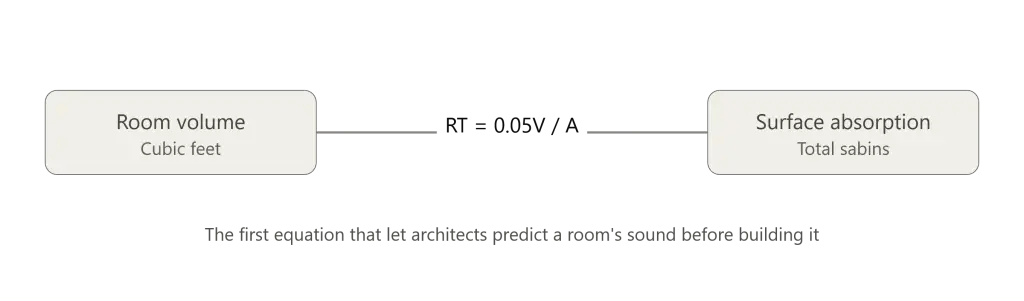
The history of acoustics changed permanently between 1895 and 1900, when physicist Wallace Clement Sabine conducted a series of careful experiments at Harvard University’s Fogg Art Museum, whose lecture hall suffered from notoriously poor speech intelligibility. Sabine methodically measured how reverberation time changed as he added or removed absorptive materials, seat cushions, and draperies from the space, and from those measurements he derived what remains the foundational equation of architectural acoustics: reverberation time is proportional to a room’s volume divided by its total surface sound absorption.
That discovery gave architects, for the first time in the entire history of acoustics, a genuine predictive tool rather than accumulated intuition. Sabine’s reputation from this work led directly to his appointment as acoustical consultant for Boston’s new Symphony Hall, completed in 1900, where he applied his equation directly to the hall’s proportions and surface treatments. More than a century later, Boston Symphony Hall remains a benchmark against which other concert venues are measured, proof that Sabine’s mathematically grounded approach could produce results that rivaled or exceeded what centuries of purely empirical practice had achieved.
6. The Twentieth Century: Acoustics Becomes an Engineering Discipline
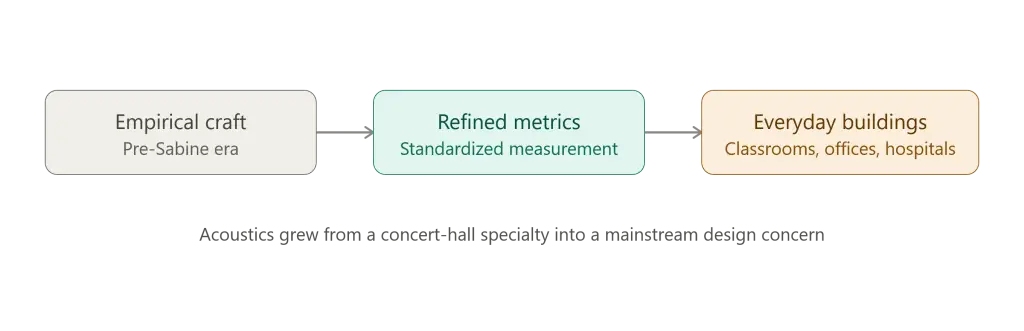
Following Sabine’s breakthrough, the history of acoustics rapidly professionalized into a distinct engineering discipline with its own standards, metrics, and specialized consultants. Researchers refined Sabine’s original reverberation formula, developing complementary metrics like early decay time, which better captures how reverberant a space actually feels to a listener, and standardized measurement protocols that let acousticians compare buildings meaningfully across different countries and eras. Acoustic consulting itself became a recognized profession, with specialists brought onto major building projects from the earliest design stages rather than consulted only after construction revealed a problem.
This period also saw acoustic science expand well beyond concert halls and theaters into everyday building types. Classrooms, offices, hospitals, and restaurants all became subjects of serious acoustic research, driven by growing evidence that poor acoustic design carried measurable consequences for learning, productivity, and patient recovery, not just concert-going enjoyment. That broadening scope transformed acoustics from a specialized concern for a handful of prestigious performance venues into a mainstream consideration relevant to nearly every building type architects design.
7. Computational Acoustics and Where the Field Stands Today
The most recent chapter in the history of acoustics is defined by computational modeling, which now lets acousticians simulate exactly how a proposed room geometry and material palette will sound before a single wall is actually built. Contemporary acoustic design combines Sabine’s original equation with parametric computer simulation, evaluating sophisticated metrics like the clarity index and initial-time delay gap alongside traditional reverberation time, allowing architects to test and refine acoustic performance digitally in ways that would have been unimaginable to Sabine working with hand calculations and physical scale models.

That computational capability has made previously difficult acoustic challenges genuinely solvable, including designing dual-purpose halls capable of serving both symphonic music and spoken presentation reasonably well, a balancing act that eluded acousticians for decades after Sabine’s initial breakthrough. Even as tools have grown far more sophisticated, however, the questions computational acoustics attempts to answer remain the same ones ancient Greek builders were already solving intuitively at Epidaurus: how does this specific room shape and this specific set of materials actually deliver sound to the people sitting inside it.
Key Facts: History of Acoustics at a Glance
| Era | Development |
|---|---|
| Prehistoric to early civilization | Instinctive concentric seating shaped by human voice directivity |
| c. 330 to 320 BCE | Theater of Epidaurus built, attributed to Polykleitos the Younger |
| 1st century BCE | Vitruvius documents Greek acoustic knowledge in Ten Books on Architecture |
| Medieval to early modern era | Empirical, craft-based acoustic design without predictive formulas |
| 1895 to 1900 | Wallace Sabine’s Fogg Art Museum and Boston Symphony Hall research |
| Early 1900s | Sabine’s reverberation time formula published and applied |
| 20th century | Acoustics professionalizes into a distinct engineering discipline |
| 21st century | Computational modeling and parametric acoustic design |
Frequently Asked Questions About the History of Acoustics
What is the history of acoustics in architecture?
The history of acoustics traces the evolution from instinctive, voice-directed seating arrangements in ancient gathering spaces to the precisely engineered Greek amphitheaters of the fourth century BCE, and eventually to the mathematically grounded science established by physicist Wallace Sabine around 1900, which remains the foundation of modern architectural acoustics.
Why was the Theater of Epidaurus acoustically significant?
The Theater of Epidaurus, built around 330 to 320 BCE, is one of the most celebrated achievements in the history of acoustics because its semicircular limestone seating reportedly carried unamplified speech clearly to audiences of up to fourteen thousand people, a result modern researchers attribute partly to sound reflections off the seating rows themselves.
What did Vitruvius contribute to the history of acoustics?
Roman architect Vitruvius documented Greek acoustic knowledge in his first-century BCE text, Ten Books on Architecture, preserving detailed guidance on seating geometry and acoustic reasoning that might otherwise have been lost, making his writings one of the most important early records in the history of acoustics.
Who is considered the founder of modern architectural acoustics?
Physicist Wallace Sabine is considered the founder of modern architectural acoustics, a pivotal figure in the history of acoustics whose experiments at Harvard’s Fogg Art Museum between 1895 and 1900 established reverberation time as a measurable, predictable quantity, directly shaping his acoustical consulting work on Boston Symphony Hall.
How did acoustics change after Wallace Sabine’s discoveries?
After Sabine, the history of acoustics moved from empirical craft knowledge toward a recognized engineering discipline, with refined metrics, standardized measurement methods, and specialized acoustic consultants applied to concert halls as well as everyday spaces like classrooms, offices, and hospitals.
How does computational modeling fit into the history of acoustics?
Computational modeling represents the most recent chapter in the history of acoustics, allowing architects to simulate a room’s acoustic performance digitally before construction, combining Sabine’s original reverberation equation with parametric tools that evaluate metrics like clarity index and early decay time.
Related Posts from Architecture Associate
- Sound in Architecture: 7 Bold Ways We Perceive It
- Light in Architecture: 7 Bold Ways We Perceive It
- Google Bay View Campus: 7 Bold Facts on Its Design
- Seattle Convention Center Summit: 6 Bold Facts to Know
Explore more architecture theory and design science content in the Architecture category on Architecture Associate, and if you want to build your dream house or interior space, you may also contact us.
External References
- Journal of the Acoustical Society of America, Origins of Building Acoustics: acoustics.org
- Journal of the Acoustical Society of America, Pre-Sabine Room Acoustics: pubs.aip.org
- Britannica, Acoustics and Reverberation Time: britannica.com
Final Thoughts
The history of acoustics is ultimately a story about closing the gap between what worked and why it worked. Ancient builders at Epidaurus achieved acoustic results so precise that researchers are still studying them more than two thousand years later, yet they had no formula, only careful observation and inherited craft.
Wallace Sabine’s turn-of-the-century breakthrough finally supplied that missing formula, and every subsequent development, from professionalized acoustic consulting to today’s computational modeling, has built directly on his foundation. What began as people instinctively seeking out the best seat to hear a speaker has become a genuine engineering science, though the underlying question, how a room’s shape and materials actually deliver sound to a listener, has remained exactly the same since the very beginning.