

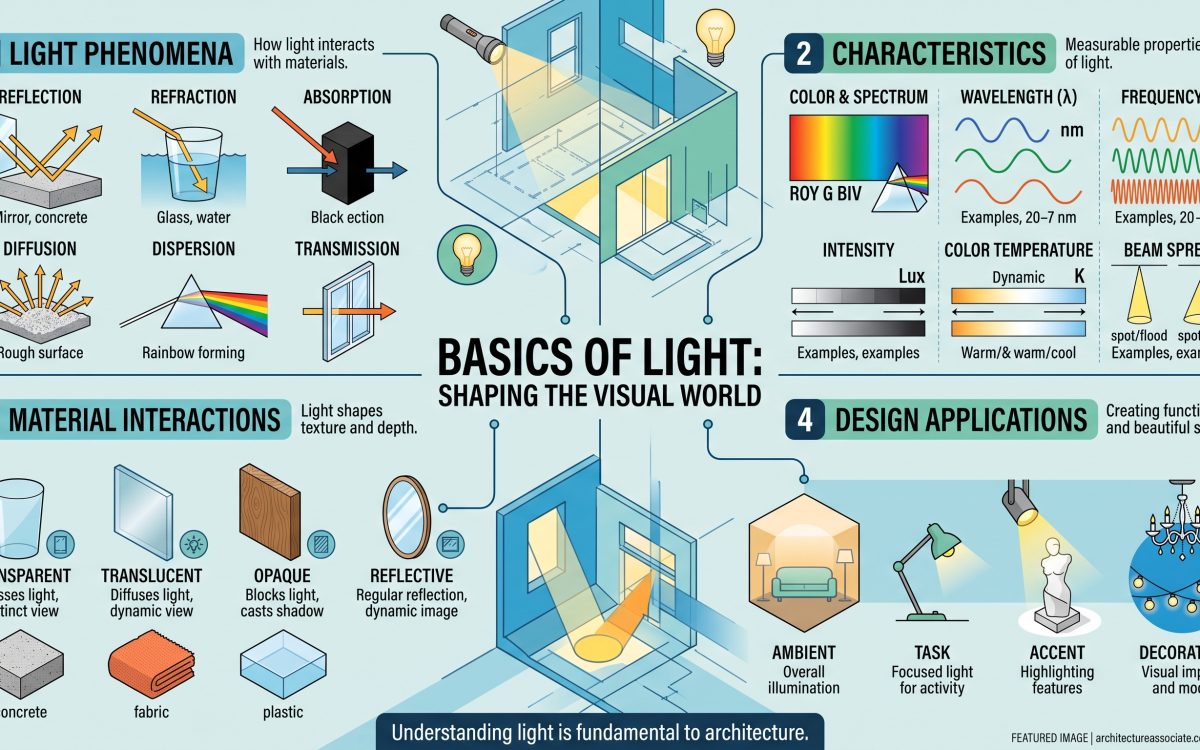
Sensitive designers have always understood something that is easy to state but genuinely difficult to design for: what a person sees is never just the quality of the physical design itself, but a consequence of both that design and the quality of light falling on it. Getting the basics of light right means treating light as a genuine design material with its own vocabulary and measurable properties, not simply flipping a switch or adding another window until a room feels bright enough.
That vocabulary matters because quantity and quality of light are genuinely different things, measured differently and experienced differently. A room can meet every illuminance target on a lighting schedule and still feel harsh, flat, or visually uncomfortable, because illuminance alone says nothing about how that light is distributed, what color it renders, or how bright any given surface actually appears to the eye. Photometry, the science underlying the basics of light, exists precisely to give architects and lighting designers a shared, measurable language for these distinctions, built around a small set of core units: the lumen, the candela, the lux, and the increasingly important measure of luminance.
This guide walks through the complete set of basics of light every designer needs — the core photometric units and what each one actually measures, the crucial difference between illuminance and luminance, how light quality shapes perception independent of quantity, color temperature and the Color Rendering Index, the direct-indirect-diffuse spectrum of light distribution, daylight factor as a design metric, and how these fundamentals come together in real design decisions.
What Are the Basics of Light in Architecture?
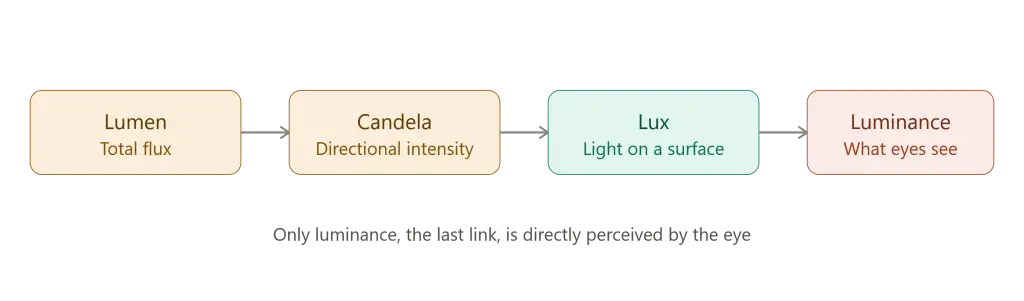
The basics of light in architecture encompass the photometric units and perceptual principles that let designers measure, predict, and control how illumination shapes a space. Luminous flux, measured in lumens, describes the total light output of a source, while luminous intensity, measured in candela, describes how much of that output travels in a specific direction.
Illuminance, measured in lux, describes how much light actually reaches a surface, while luminance, measured in candela per square meter, describes how bright that surface appears to an observer looking at it, the only one of these four quantities the human eye directly perceives. Color temperature, measured in Kelvin, and the Color Rendering Index, scored from 0 to 100, together describe the character and quality of that light rather than its quantity.
1. Luminous Flux and Luminous Intensity: Where Light Begins
Understanding the basics of light starts at the source itself, before that light ever reaches a wall, a face, or a page. Luminous flux, measured in lumens, describes the total quantity of visible light a source emits in every direction, a single number representing the source’s overall output. A source emitting one candela of uniform intensity across a full sphere produces roughly 12.57 lumens, since luminous flux is fundamentally the product of intensity and the solid angle over which light spreads.
Luminous intensity, measured in candela, narrows that picture to a specific direction rather than the source’s total output. A spotlight and a bare bulb might emit the same total lumens, yet the spotlight concentrates nearly all of that output into a narrow beam, giving it a dramatically higher candela rating in that specific direction even though its overall luminous flux is comparable. This distinction, between how much light a source makes and where that light actually goes, is the first genuinely consequential concept within the basics of light, because a fixture selected purely on lumen output can still fail to deliver usable light exactly where a design actually needs it.
2. Illuminance: Measuring Light on a Surface
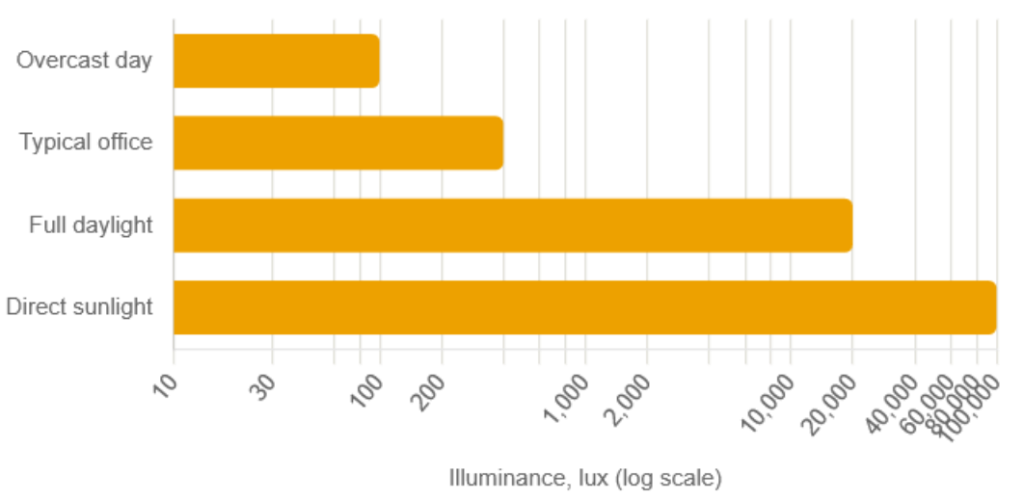
Once light leaves its source, the basics of light shift focus from the fixture to the surface that light actually strikes. Illuminance, measured in lux, describes the density of luminous flux landing on a given area, calculated simply as lumens divided by square meters. A dim, overcast day measures around 100 lux, ordinary office lighting typically falls between 300 and 500 lux, full daylight can reach 10,000 to 25,000 lux, and direct summer sunlight can climb as high as 100,000 lux, a range spanning three full orders of magnitude that illustrates just how dramatically natural conditions vary compared to the comparatively narrow band architects specify for interior spaces.
Illuminance depends on more than raw source output. The angle at which light strikes a surface matters directly, since light arriving at 60 degrees from perpendicular delivers only half the illuminance of the same light striking straight on, a relationship governed by the cosine of the incidence angle. Illuminance also depends heavily on external factors invisible to the fixture itself, including reflections bouncing off nearby walls and the contribution of every other light source in the room, which is precisely why a single lux rating printed on a light fixture’s packaging can never fully predict how a finished space will actually perform once installed.
3. Luminance: What the Eye Actually Perceives
Here the basics of light introduce their single most important distinction for design quality. Illuminance cannot be directly detected by the human eye; it is a calculated quantity used to verify that a space receives adequate light for its intended tasks. Luminance, by contrast, measured in candela per square meter, describes the brightness of a surface as it is actually perceived by someone looking at it, making luminance the only photometric quantity among the basics of light that corresponds directly to visual experience rather than to an abstract measurement taken with a meter.
That distinction has real design consequences. Two rooms can register identical illuminance readings on a light meter while looking completely different to an occupant, because luminance also depends on how reflective each surface is and how concentrated the light source appears from a given viewing angle. A small, extremely bright light source emitting the same total lumens as a large, diffuse one will register a dramatically higher luminance, and that higher luminance is precisely what produces glare, since the eye responds to concentrated brightness rather than to total light output.

The human eye can process an enormous luminance range, from roughly one-millionth of a candela per square meter under starlight up to values exceeding a million under direct sunlight, though within any single scene the eye typically manages a far narrower working range of around a thousand to one, which is why poorly controlled contrast between a bright window and a dim interior can feel genuinely uncomfortable even when both individually fall within the eye’s theoretical capability.

4. Color Temperature and the Color Rendering Index
Beyond sheer quantity, the basics of light include two measures describing the character of light rather than how much of it exists. Color temperature, measured in Kelvin, describes whether a light source appears warm or cool: lower Kelvin values produce warmer, more yellow-toned light reminiscent of candlelight or early incandescent lamps, while higher Kelvin values produce cooler, more blue-white light closer to overcast daylight. This single number shapes how a space feels far more than its raw brightness does, which is why the same illuminance level can read as cozy or clinical depending entirely on the color temperature selected.
The Color Rendering Index, scored on a scale from 0 to 100, measures a separate but equally important quality: how accurately a light source reveals the true colors of objects compared to natural daylight. Most incandescent lamps achieve a CRI near 100, while LED and fluorescent sources vary considerably, with most modern fixtures managing 80 or better but few exceeding 90. A CRI below roughly 85 begins to visibly distort colors, an effect most obvious in spaces like retail displays, art galleries, and medical examination rooms, where accurate color perception is not a decorative preference but a genuine functional requirement built directly into the basics of light a designer must specify correctly.

5. Direct, Indirect, and Diffuse Light Distribution
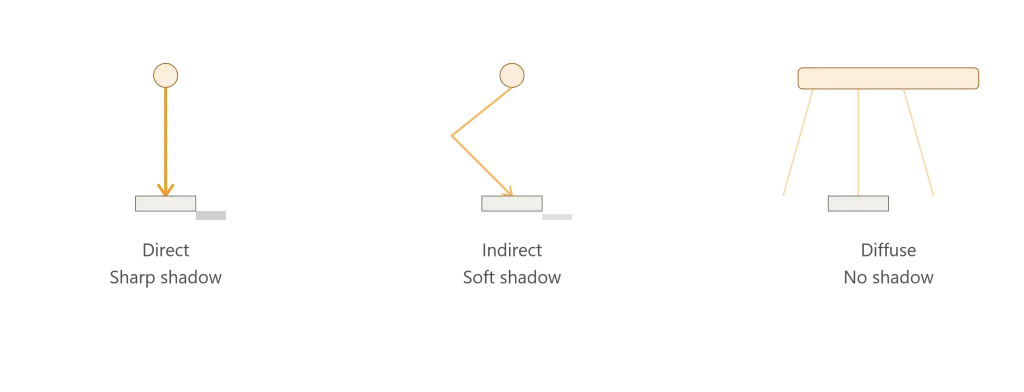
How light travels from source to surface represents another core element of the basics of light, since the same total illuminance can be delivered through dramatically different distribution strategies. Direct light travels straight from source to surface with minimal intervening reflection, producing sharp shadows, strong contrast, and a clearly legible sense of where the light is actually coming from, a quality well suited to task lighting or dramatic accent effects. Indirect light instead bounces off an intermediate surface, typically a ceiling or wall, before reaching its target, softening shadows considerably and producing a more even, ambient quality of illumination throughout a room.
Diffuse light sits at a further extreme, scattered so thoroughly across a broad source or through a translucent diffusing material that shadows nearly disappear entirely, a quality overcast daylight demonstrates naturally and one architects often replicate artificially using frosted glazing or indirect cove lighting. Choosing among direct, indirect, and diffuse strategies, or more often blending them deliberately within a single room, is where the abstract units within the basics of light translate directly into the felt experience of a finished space, since the same lumen output distributed these three different ways produces three genuinely different rooms.
6. Daylight Factor: A Practical Design Metric
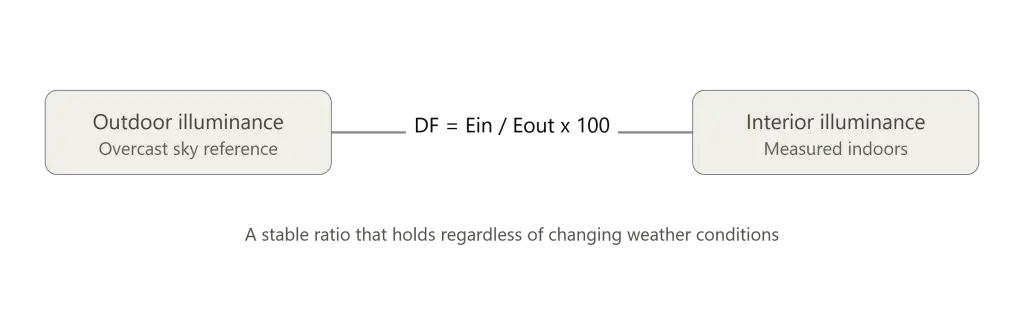
Among the more practically useful tools within the basics of light is the daylight factor, a metric that expresses interior illuminance as a simple percentage of the illuminance available simultaneously outdoors under an overcast sky. Rather than predicting a single absolute lux value that will vary constantly with weather and time of day, daylight factor gives architects a stable ratio they can calculate during design and rely on across genuinely different sky conditions, since an overcast sky provides a consistent, diffuse reference condition unlike direct sunlight’s constantly shifting intensity and angle.
A higher daylight factor throughout a room indicates more generous, better-distributed daylight penetration, while a daylight factor concentrated heavily near windows and dropping sharply toward the interior signals a floor plate that will depend heavily on electric lighting for anything beyond its perimeter zone. Because it is calculated relative to outdoor conditions rather than as an absolute figure, daylight factor remains one of the more durable and widely used metrics within the basics of light, letting architects compare daylighting performance meaningfully across buildings, climates, and seasons using a single consistent number.
7. Bringing the Basics Together in Real Design Decisions
None of these individual concepts within the basics of light functions in isolation once a design actually gets built. A room can hit its illuminance target on paper while still producing uncomfortable glare if the luminance of its light sources is left unchecked, or it can achieve superb color rendering while feeling visually flat if every surface receives identical diffuse light with no directional contrast at all. Genuinely skilled lighting design treats these measures as an interdependent system, balancing quantity against quality, direct against diffuse, and daylight against electric supplementation, rather than optimizing any single photometric number in isolation.
That systems view is precisely what separates a lighting scheme that merely satisfies a code-minimum illuminance schedule from one that actually shapes how a space feels to occupy. Sensitive designers have always worked this way instinctively, layering direct task light where focused attention is needed, indirect ambient light to establish a room’s general character, carefully selected color temperature to set an emotional register, and genuine daylight access wherever the daylight factor calculation shows it will actually reach. The basics of light give that instinct a measurable, communicable vocabulary, letting a design intention be specified, verified, and reproduced rather than left to chance.
Key Facts: Basics of Light at a Glance
| Quantity | Unit | What It Measures |
|---|---|---|
| Luminous flux | Lumen (lm) | Total light output of a source |
| Luminous intensity | Candela (cd) | Light output in a specific direction |
| Illuminance | Lux (lx) | Light falling on a surface, lm per sq m |
| Luminance | cd per sq m | Perceived brightness of a surface |
| Color temperature | Kelvin (K) | Warmth or coolness of light color |
| Color Rendering Index | CRI, 0 to 100 | Accuracy of color reproduction |
| Daylight factor | Percentage | Interior illuminance relative to overcast sky |
| Typical office illuminance | 300 to 500 lux | Standard task lighting target |
| Full daylight illuminance | 10,000 to 25,000 lux | Outdoor daytime range |
Frequently Asked Questions About the Basics of Light
What are the basics of light in architectural design?
The basics of light include the core photometric units architects and lighting designers use: lumens for total light output, candela for directional intensity, lux for illuminance on a surface, and luminance for perceived surface brightness, alongside color temperature and the Color Rendering Index, which describe the character rather than the quantity of light.
What is the difference between illuminance and luminance?
Illuminance, measured in lux, describes how much light falls on a surface and cannot be directly perceived by the eye, while luminance, measured in candela per square meter, describes how bright that surface actually appears to an observer, making luminance the more perceptually relevant measure within the basics of light.
Why does color temperature matter in lighting design?
Color temperature, measured in Kelvin, determines whether light appears warm and yellow-toned or cool and blue-white, shaping how a space feels emotionally far more than raw brightness does, which is why understanding this concept is central to applying the basics of light effectively in any interior.
What is the Color Rendering Index and why does it matter?
The Color Rendering Index, or CRI, scored from 0 to 100, measures how accurately a light source reveals the true colors of objects compared to natural daylight. A CRI below roughly 85 begins visibly distorting colors, making this metric essential wherever accurate color perception matters, from retail to healthcare settings.
What is daylight factor and how is it used in design?
Daylight factor expresses interior illuminance as a percentage of simultaneous outdoor illuminance under an overcast sky, giving architects a stable, comparable metric for evaluating daylight penetration across different rooms and buildings, one of the most practically useful tools among the basics of light.
How do direct, indirect, and diffuse light differ?
Direct light travels straight to a surface and produces sharp shadows and strong contrast, indirect light bounces off an intermediate surface for a softer, more even quality, and diffuse light scatters so broadly that shadows nearly disappear, three distinct distribution strategies architects blend deliberately when applying the basics of light to a real space.
Related Posts from Architecture Associate
- Light in Architecture: 7 Bold Ways We Perceive It
- History of Lighting: 7 Bold Turning Points
- Sound in Architecture: 7 Bold Ways We Perceive It
- Auditorium Design Standards: 7 Bold Rules to Know
Explore more architecture theory and design science content in the Architecture category on Architecture Associate.
External References
- ICO Optics, Photometric Units Explained: ico-optics.org
- LEDVANCE, Candela vs Lux vs Lumens: ledvance.com
- 1st Source Lighting, Common Lighting Terms and Definitions: 1stsourcelighting.com
Final Thoughts
The basics of light exist precisely because “brightness” alone is too crude a concept to design with reliably. Lumens tell you what a source produces, candela tells you where that output travels, lux tells you what actually lands on a surface, and luminance, the only one of these your eye truly sees, tells you how bright that surface will actually appear. Layer in color temperature, color rendering, distribution strategy, and daylight factor, and what once felt like an intuitive, almost mystical design skill becomes a genuinely measurable discipline. Sensitive designers understood this long before photometry had a name for it; the science simply gave their instinct a vocabulary precise enough to specify, verify, and repeat.