

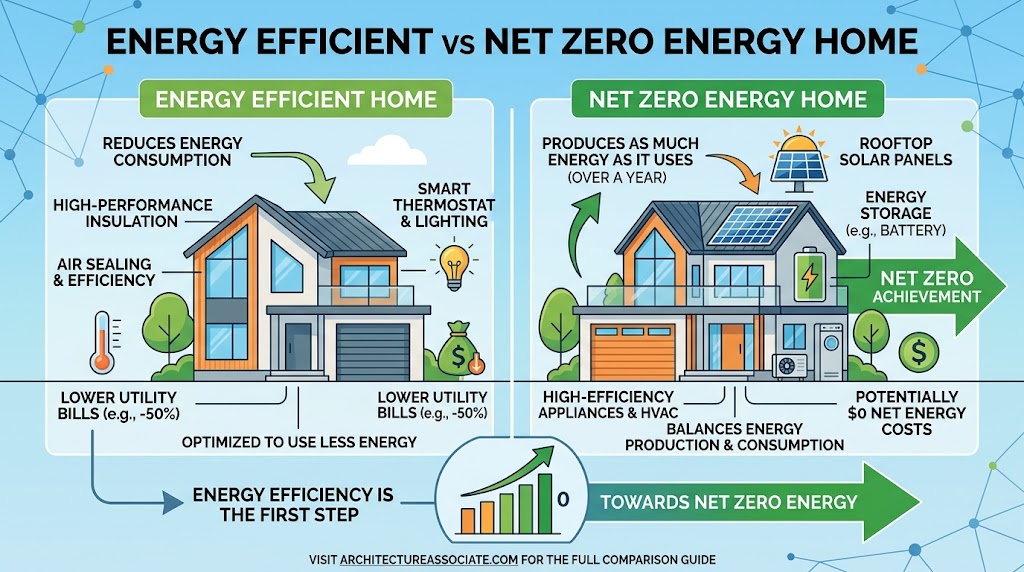
Homeowners researching net-zero vs energy-efficient homes often assume these terms describe roughly the same thing at different intensities. They do not. Energy efficiency describes how little energy a home consumes relative to a baseline; net-zero describes a mathematical outcome, whether a home’s on-site renewable generation offsets its total annual consumption. A home can be genuinely, rigorously energy-efficient and still fall considerably short of net-zero, while a comparatively inefficient home can technically reach net-zero simply by installing enough solar panels to outproduce its wasteful consumption.
That distinction matters enormously for anyone budgeting a renovation or new build, because the two goals require different investments in a different order. An energy-efficient home prioritizes reducing consumption through insulation, air sealing, and efficient equipment, often certified through programs like ENERGY STAR, without any requirement to generate power on-site.
A net-zero home adds a further requirement on top of that foundation: enough renewable generation, almost always rooftop solar, to produce as much energy as the home consumes over a full year. Understanding net-zero vs energy-efficient as two related but genuinely distinct goals, rather than points on the same scale, changes how a homeowner should actually sequence and budget their project.
This guide walks through the complete comparison of net-zero vs energy-efficient homes — what energy efficiency actually means and how it’s certified, what net-zero specifically requires beyond efficiency, the Zero Energy Ready Home program that bridges the two, how the HERS Index measures both categories differently, how Passive House fits into this picture, and a practical framework for deciding which goal actually makes sense for a given project.
What Is the Difference Between Net-Zero and Energy-Efficient Homes?
The core difference in net-zero vs energy-efficient homes is that energy efficiency measures reduced consumption relative to a baseline, while net-zero measures whether on-site renewable generation offsets total annual consumption entirely. An energy-efficient home, often certified through ENERGY STAR, uses less energy than a comparable code-built home through better insulation, air sealing, and efficient appliances, but carries no requirement to generate any of its own power.
A net-zero home must go further, producing as much energy on-site, almost always through solar photovoltaic panels, as it consumes over a full year, a distinction the Department of Energy’s Zero Energy Ready Home program explicitly bridges by requiring the efficiency of a near-net-zero home without mandating the renewable generation itself.
1. Energy-Efficient Homes: What the Term Actually Means
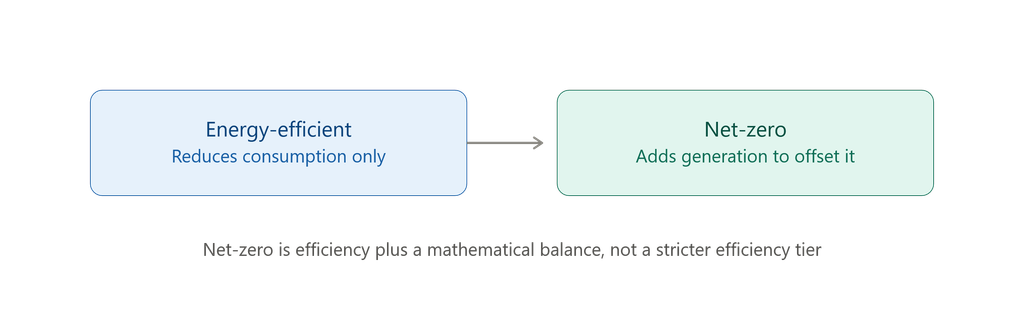
Within the net-zero vs energy-efficient comparison, energy efficiency is the more modest and more common goal, describing a home built or renovated to use meaningfully less energy than a standard code-built house. ENERGY STAR-certified homes represent the most widely recognized version of this standard, built to EPA-established requirements covering proper insulation, high-performance windows, airtightness, and efficient mechanical systems, verified through third-party testing and evaluation rather than self-reported claims. These homes deliver genuine energy savings and improved comfort without any obligation to offset their remaining consumption through on-site generation.
That distinction, efficiency without generation, is precisely what separates this category from net-zero within the broader net-zero vs energy-efficient conversation. An ENERGY STAR home might reduce energy consumption by a meaningful percentage compared to a standard new build, delivering real utility bill savings and improved indoor comfort, but it makes no claim about producing any of its own power. That makes energy efficiency alone a considerably more accessible and lower-cost goal than net-zero, since it avoids the added expense of a properly sized solar array and the roof, orientation, and structural considerations that come with it.
2. Net-Zero Homes: A Mathematical Balance, Not Just Efficiency
Net-zero represents a fundamentally different kind of claim within the net-zero vs energy-efficient distinction: it is a mathematical achievement rather than a design philosophy. Over the course of a full year, a net-zero home produces as much energy as it consumes, typically accomplished through a combination of on-site renewable generation, usually rooftop solar photovoltaics, paired with high-efficiency heat pumps, battery storage, and energy-efficient appliances and lighting working together to keep consumption low enough for a reasonably sized solar array to offset entirely.
Because net-zero is fundamentally an arithmetic outcome rather than a fixed construction standard, it is possible, at least in principle, to make almost any home net-zero given enough investment in renewable generation. A home with mediocre insulation and inefficient mechanical systems could theoretically reach net-zero performance simply by installing an unusually large, expensive solar array capable of outproducing its wasteful consumption.
In practice, however, pursuing net-zero without first addressing efficiency is rarely cost-effective, since every dollar spent on insulation and air sealing reduces the size, and therefore the cost, of the solar array eventually required to close the remaining gap. This is precisely why serious net-zero projects treat efficiency as the necessary first phase of the work, not a separate, optional consideration within the net-zero vs energy-efficient framework.
3. Zero Energy Ready Homes: The Bridge Between the Two
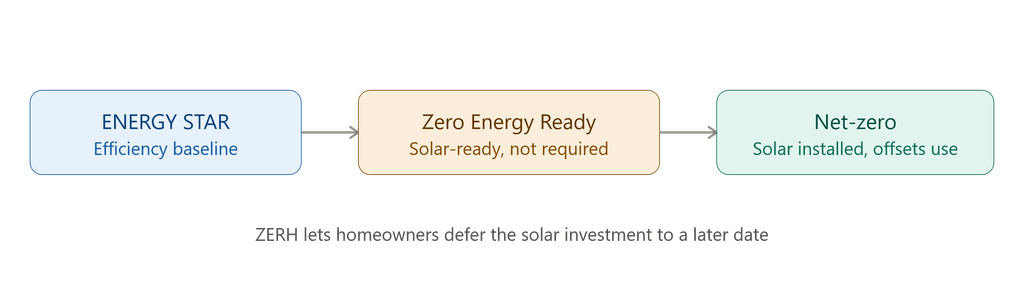
Sitting directly between these two categories, the Department of Energy’s Zero Energy Ready Home, or ZERH, program offers a genuinely useful middle path within the net-zero vs energy-efficient landscape. A ZERH-certified home includes all of the ENERGY STAR requirements and goes further, built so efficiently that all or most of its annual energy consumption could be offset by a modestly sized renewable energy system, without actually requiring that system to be installed at the time of construction. The Department of Energy has described these homes as being at least 40 to 50 percent more energy efficient than a typical new home, generally carrying a HERS Index score in the low to mid-50s.
That framing, efficient enough to become net-zero later without being net-zero now, gives homeowners genuine flexibility. ZERH homes are typically built with the conduit, structural provisions, and electrical capacity needed to add solar later, letting a homeowner defer the renewable generation investment to a point when budget allows, while still capturing nearly all the efficiency benefits of a true net-zero build today.
That said, ZERH certification is specifically a builder-facing program: homeowners themselves cannot apply for it directly, and the associated federal tax credit under Section 45L of the Inflation Reduction Act, worth up to 5,000 dollars per home, is claimed by builders and developers rather than homeowners purchasing an already-built home.
4. HERS Index: How the Same Metric Describes Both Categories
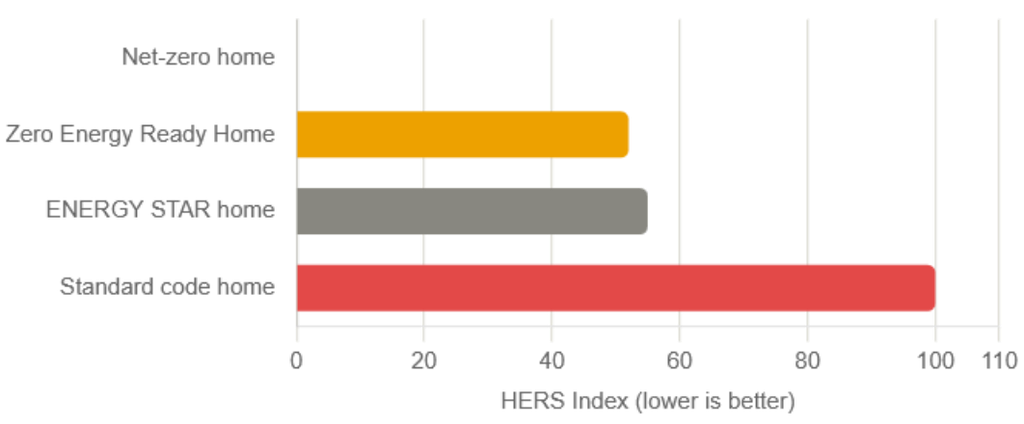
The Home Energy Rating System, or HERS Index, provides a useful shared measuring stick across the net-zero vs energy-efficient comparison, since both categories can be expressed on the same numeric scale even though they represent different goals. A HERS Index of 100 represents a home built to 2006 energy code baseline performance, while a HERS Index of 0 represents genuine net-zero performance, meaning the home produces as much energy as it consumes.
Standard new energy-efficient homes commonly score between 40 and 70 on this scale, while ZERH-certified homes typically land in the low to mid-50s before any solar has been added, and true net-zero homes reach 0 specifically because their on-site generation cancels out their remaining net consumption on the same annual accounting basis.
That shared scale makes the practical difference between the categories genuinely visible: a HERS score alone tells you how efficient a home’s underlying construction is, but only a home that has actually added sufficient renewable generation, and been verified through monitored performance data, can claim the specific HERS Index of 0 associated with true net-zero status.
A homeowner comparing quotes or certifications within the net-zero vs energy-efficient landscape should ask specifically which HERS Index a given home or renovation target is designed to reach, and whether that number already accounts for planned solar generation or reflects the building envelope alone.
5. Where Passive House Fits Into the Picture
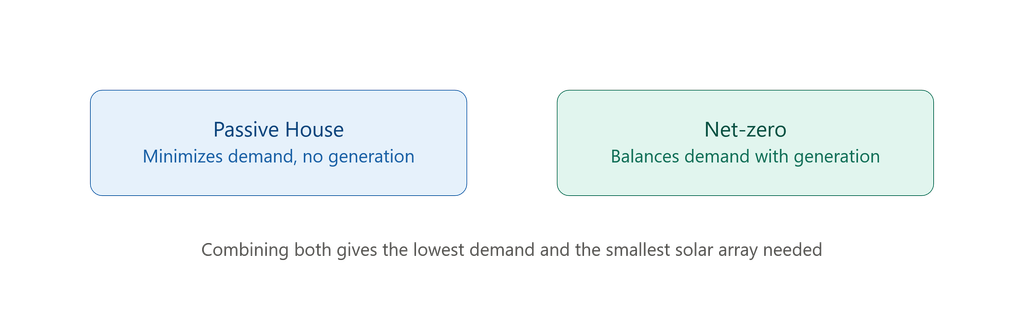
A third standard frequently enters the net-zero vs energy-efficient conversation and adds genuine confusion: Passive House. Rather than pursuing net-zero’s mathematical balance between consumption and generation, Passive House pursues energy efficiency through rigorous, quantifiable design principles, an extremely airtight building envelope, elimination of thermal bridging, and continuous, thick insulation, aimed at minimizing energy demand to the lowest level physically practical before any renewable generation is even considered.
A Passive House and a net-zero home can overlap considerably in construction technique, since both benefit from an airtight, well-insulated envelope, but Passive House itself makes no claim about on-site power generation the way net-zero does.
The most robust projects increasingly combine both approaches rather than treating them as competing standards, using a Passive House-level building envelope paired with a solar array sized to that already-minimized consumption. That combination, sometimes formalized through certification programs explicitly built around pairing rigorous passive design with appropriately sized renewables, delivers a home that performs reliably during grid outages, extreme weather, and rising energy prices alike, precisely because its baseline consumption is already so low that the renewable generation required to reach net-zero becomes genuinely modest and affordable.
Cost and Certification Differences Worth Knowing
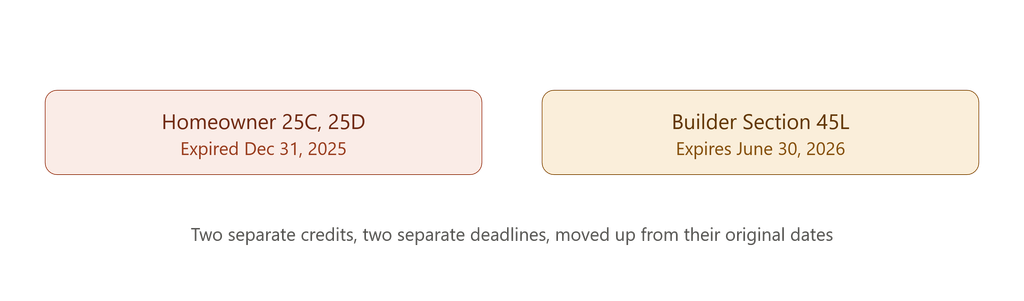
Beyond definitions, the net-zero vs energy-efficient distinction carries real cost and incentive implications that shifted meaningfully heading into 2026. Builders and developers, not individual homeowners, can still claim up to 5,000 dollars per dwelling unit under Section 45L for homes certified to DOE Zero Energy Ready standards, and up to 2,500 dollars for homes meeting ENERGY STAR requirements, though this builder-facing credit now expires for homes acquired after June 30, 2026, moved up considerably from its original 2032 expiration date.
Homeowners pursuing net-zero performance directly on an existing home, meanwhile, no longer have access to the 30 percent federal residential credits that covered solar and efficiency upgrades through 2025, since those credits expired for property placed in service after December 31, 2025.
That shifting incentive landscape makes the underlying cost difference between the two goals more consequential than it once was. Energy-efficient upgrades alone, insulation, air sealing, efficient windows, typically deliver strong payback even without any tax credit support, since the improvements reduce utility bills directly regardless of federal policy changes. Net-zero performance, which adds a full solar array on top of that efficiency work, now depends more heavily on state and utility rebate programs to remain cost-effective than it did when a uniform 30 percent federal credit applied to both efficiency and generation investments alike.
Which Goal Should You Actually Pursue?
Deciding between net-zero vs energy-efficient as a renovation or construction target ultimately depends on budget, timeline, and how a homeowner weighs upfront cost against long-term energy independence. Homeowners working with a genuinely constrained budget, or planning to add solar later once finances allow, are often better served pursuing efficiency first, potentially targeting ZERH-level performance that leaves the home structurally and electrically ready for solar without requiring that investment immediately. This sequencing captures the majority of the comfort, air quality, and utility bill benefits associated with net-zero construction while deferring the single largest remaining expense.
Homeowners prioritizing genuine energy independence, resilience against grid outages, or protection against rising utility rates, and who have the budget to pursue both efficiency and generation simultaneously, are better served treating net-zero as the actual target from the outset. In either case, the underlying sequencing logic remains identical regardless of which final goal a homeowner chooses: envelope and mechanical efficiency work should always come first, since it directly determines how large, and how expensive, any eventual solar array actually needs to be to close the remaining gap.
Key Facts: Net-Zero vs Energy-Efficient at a Glance
| Category | Requires On-Site Generation | Typical HERS Index |
| ENERGY STAR certified | No | 40 to 70 |
| DOE Zero Energy Ready Home (ZERH) | No, but solar-ready | Low to mid-50s |
| Passive House | No | Varies, very low consumption |
| Net-zero energy home | Yes | 0 |
| Builder 45L tax credit (ZERH) | N/A | Up to $5,000 per unit, expires June 30, 2026 |
| Builder 45L tax credit (ENERGY STAR) | N/A | Up to $2,500 per unit, expires June 30, 2026 |
| Homeowner federal 25C/25D credits | N/A | Expired after Dec 31, 2025 |
Frequently Asked Questions About Net-Zero vs Energy-Efficient Homes
What is the main difference between net-zero and energy-efficient homes?
The core distinction in net-zero vs energy-efficient homes is that energy efficiency measures reduced consumption without requiring on-site power generation, while net-zero requires enough renewable generation, almost always solar, to offset a home’s total annual energy consumption entirely.
Is a Zero Energy Ready Home the same as a net-zero home?
No. A DOE Zero Energy Ready Home is built efficiently enough that a modest renewable system could offset most or all of its energy use, but it does not require that system to actually be installed, making it a bridge between energy-efficient and net-zero within the broader net-zero vs energy-efficient comparison.
What HERS Index score counts as net-zero?
A HERS Index of 0 represents true net-zero performance, meaning the home’s on-site generation offsets its total consumption, while standard energy-efficient homes typically score between 40 and 70, and ZERH-certified homes typically land in the low to mid-50s before solar is added.
Is Passive House the same as net-zero?
No. Passive House is an energy-efficiency standard focused on minimizing consumption through an extremely airtight, well-insulated envelope, with no requirement for on-site renewable generation, while net-zero specifically requires generation sufficient to offset annual consumption, a key distinction in the net-zero vs energy-efficient debate.
Which costs more, an energy-efficient home or a net-zero home?
Net-zero homes generally cost more upfront than energy-efficient homes alone, since they add a full solar array, and often battery storage, on top of the same efficiency investments, though a well-sequenced envelope-first approach can meaningfully reduce the size and cost of that additional solar array.
Should I build energy-efficient now and add solar later?
For many homeowners, yes. Targeting Zero Energy Ready or similarly efficient performance now, while leaving structural and electrical capacity for solar, is a reasonable middle path within the net-zero vs energy-efficient decision, letting a homeowner defer the largest remaining cost until budget allows.
Related Posts from Architecture Associate
- Net-Zero Home Renovation: Complete Guide to Costs & ROI
- How to Convert an Existing Home to Net-Zero Energy
- Best Solar Panel Systems for Net-Zero Home Renovations
- Net-Zero Home Renovation Cost Breakdown by State
Explore more sustainable design and energy performance guides in the Architecture category on Architecture Associate.
External References
- Green Builder Media, ENERGY STAR Versus Zero Energy Ready Primer: greenbuildermedia.com
- Zero Energy Project, Net-Zero vs Passive House: zeroenergyproject.com
- Eco Windows USA, Passive House vs Net Zero in 2026: ecowindowsusa.com
Final Thoughts
Net-zero vs energy-efficient is not a matter of degree, one modest and one ambitious version of the same goal, but two genuinely different claims about a building. Efficiency describes how little a home wastes; net-zero describes whether that home’s own generation covers what it still uses.
Understanding that distinction, and the Zero Energy Ready and Passive House standards sitting between them, gives homeowners a genuinely useful framework for sequencing a real project: build or renovate for efficiency first, since that investment pays for itself reliably regardless of shifting federal incentives, then add exactly as much renewable generation as the resulting, already-reduced consumption actually requires. Whichever label ends up on the finished home, that underlying order rarely changes.
If You want to build your dream space or interior you may contact with us or at Architecture Associate