

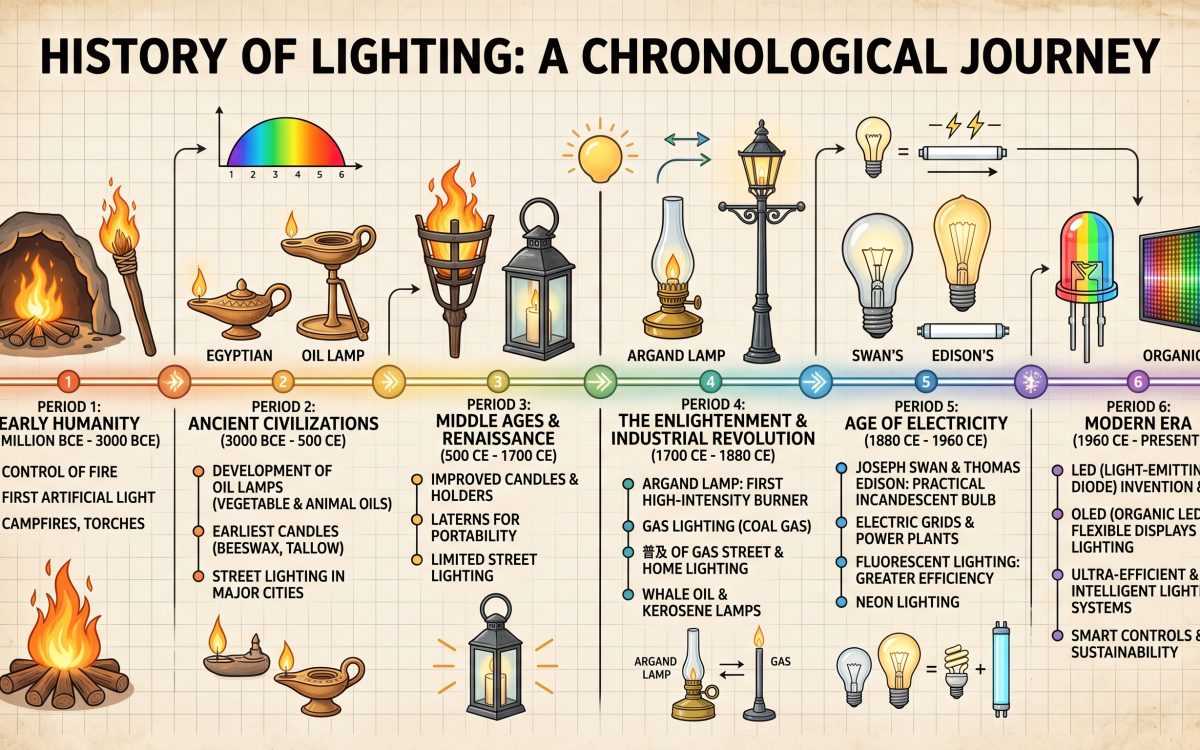
Throughout most of architectural history, daylight has been the primary source of light inside a building, supplemented only by burned fuels once the sun went down. The history of lighting in architecture is, for most of its span, really a history of controlling daylight rather than manufacturing it, since electric illumination did not exist until a startlingly recent moment in a story that otherwise stretches back thousands of years. Beyond simple illumination, daylight itself carried symbolic weight across nearly every culture that built with it, standing for cleanliness, purity, knowledge, and the divine.
That symbolic charge shaped how architects actually let light into a building. In climates where daylight was already plentiful and predictably bright, builders often responded by shrinking openings or filtering light through grilles and translucent or tinted glazing, rather than flooding interiors indiscriminately. To a remarkable degree, past architecture admitted light only where it was specifically wanted, giving windows and roof openings special prominence within the overall structure.
The result was often a building with dramatic swings in brightness from room to room, where a sudden pool of daylight signaled that something significant, a shrine, an altar, a throne, was happening in that particular space. The history of lighting from that instinctive symbolism through to today’s electrically saturated interiors is a story of steadily expanding control, moving from a scarce, sacred resource to an abundant, engineered one.
This guide walks through the complete story of the history of lighting — daylight’s ancient symbolic role, the engineering breakthrough of the Pantheon’s oculus, the Gothic transformation of walls into canvases of stained glass, the Renaissance shift toward clarity and proportion, the Industrial Revolution’s expansion of glazing, the arrival of electric light, and where computational lighting design stands today.
What Is the History of Lighting in Architecture?
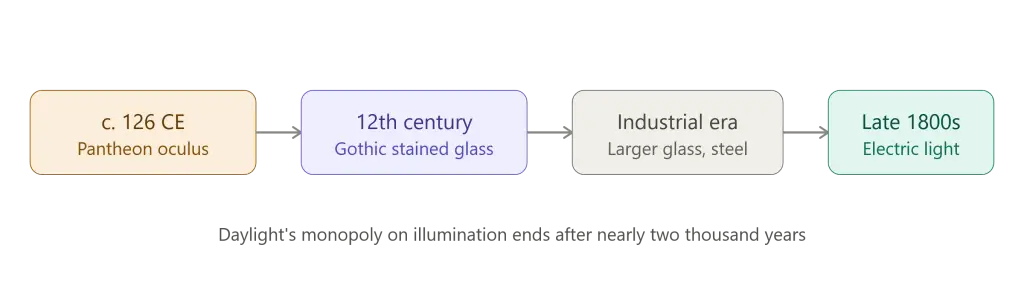
The history of lighting in architecture traces how builders moved from treating daylight as a scarce, symbolically charged resource to engineering it, and eventually electric light, with increasing precision. Ancient Roman builders achieved one of the field’s earliest engineering triumphs with the Pantheon’s oculus, completed around 126 CE, a single dome opening that remains one of the purest expressions of natural light entering a building.
Medieval Gothic architecture then transformed the wall itself into a canvas for stained glass, epitomized by structures like Sainte-Chapelle in Paris, before the Renaissance reoriented light toward clarity and proportion rather than mysticism. Industrial-era glass manufacturing, followed by the invention of electric lighting, ultimately gave architects a level of control over illumination that ancient builders could never have imagined.
1. Daylight as a Sacred and Symbolic Resource
Long before the history of lighting became a story of engineering, it was a story of meaning. Daylight functioned as far more than raw illumination in ancient and medieval architecture; it stood symbolically for cleanliness, purity, knowledge, and heaven itself, a set of associations that shaped where and how architects chose to admit it.
In climates already blessed with plentiful, predictably bright daylight, this symbolic weight often produced restraint rather than abundance: architects deliberately shrank window openings or filtered incoming light through grilles, screens, and translucent or tinted glazing, treating light as something to be rationed and directed rather than allowed to flood a space freely.
That restraint had a clear architectural consequence. Past buildings tended to admit light only where it was specifically wanted, giving windows and roof openings genuine prominence within the overall composition rather than distributing them evenly across every wall.
The result was often a building defined by dramatic contrast, dim corridors and antechambers giving way to sudden, brilliant pools of daylight marking an altar, a throne, or a shrine. That contrast was not an engineering limitation to be apologized for; it was itself a deliberate architectural language, signaling to anyone moving through the building that a genuinely significant event or space had been reached.
2. The Pantheon and the Engineering of a Single Perfect Opening

Few moments in the history of lighting carry as much weight as the construction of the Pantheon in Rome, completed under the emperor Hadrian around 126 CE. At the top of the building’s dome sits the oculus, a single circular opening measuring roughly nine meters across, cut directly into what remains the largest unreinforced concrete dome in the world. Rather than distributing daylight evenly through multiple smaller openings, Roman engineers concentrated it entirely into one dramatic aperture, creating an early and remarkably pure example of light itself being built directly into a structure’s architectural identity.
The effect the oculus produces goes well beyond simple illumination. As the sun moves across the sky throughout the day, the resulting beam of light sweeps visibly across the dome’s interior surface and down onto the floor below, connecting the enclosed space directly to the passage of time, the weather, and the sky above in a way no static window ever could.
That dynamic, ever-changing quality is precisely what has made the Pantheon a continuously studied reference point in the history of lighting, cited by architects and lighting designers many centuries after its completion as proof that a single, carefully considered opening can carry more architectural power than an entire wall of windows.
3. The Gothic Wall Becomes a Canvas for Light

By the twelfth century, a pivotal shift in the history of lighting began at the Basilica of Saint-Denis outside Paris, where Abbot Suger placed light at the literal center of religious architectural thinking. Suger’s work embodied the Gothic idea of lux nova, or new light, a movement that treated daylight passing through stained glass as something genuinely sacred, carrying color, feeling, and theological meaning rather than serving merely functional illumination. That shift fundamentally redefined what a wall was actually for.
As Gothic construction techniques matured, structural innovations including rib vaults, pointed arches, and flying buttresses let architects remove far more solid wall than earlier stone construction methods had ever allowed, opening enormous areas to be filled with colored glass.
Sainte-Chapelle in Paris stands as the clearest embodiment of this transformation: its upper chapel is formed almost entirely from stained glass, with the surviving stonework reduced to little more than a supporting frame around the luminous surfaces it holds. That reversal, wall becoming glass and structure becoming frame, represents one of the most dramatic single turns in the entire history of lighting, converting daylight itself into the primary decorative and spiritual material of an entire building type.
4. Renaissance Clarity and the Turn Away From Mysticism
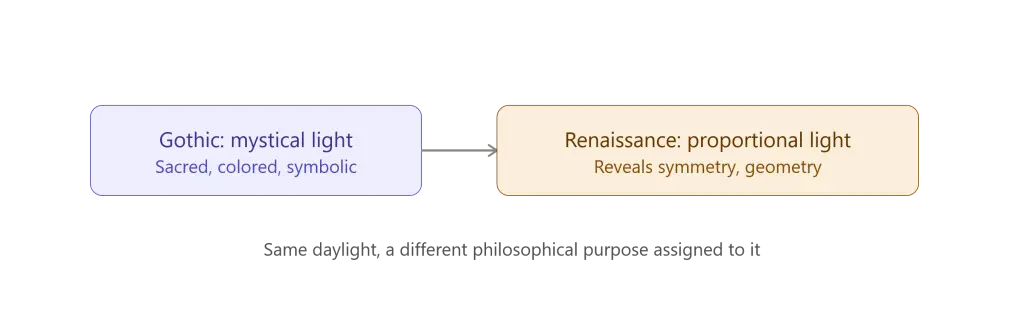
Where Gothic builders had treated light as a mystical, sacred medium, Renaissance architects approached the history of lighting from an entirely different philosophical direction. Rather than using daylight to evoke transcendence, Renaissance designers valued it primarily as a tool for achieving visual clarity, a quality that let observers appreciate a building’s proportion, geometry, and symmetry with genuine precision. Daylight became less a symbol pointing toward the divine and more a practical instrument for revealing the mathematical order Renaissance architects worked so deliberately to build into their columns, arches, and domes.
That reorientation continued into the Baroque period that followed, where architects again adjusted light’s role to suit their own dramatic and theatrical ambitions, using contrast and concentrated illumination to heighten emotional impact within grand church interiors and palace halls. Across these successive shifts, from Gothic mysticism through Renaissance clarity to Baroque drama, the underlying physical resource never changed. What changed, at each stage of the history of lighting, was the philosophical purpose architects assigned to the same daylight that had always been available to them.
5. Industrial Glass and the Expansion of the Window
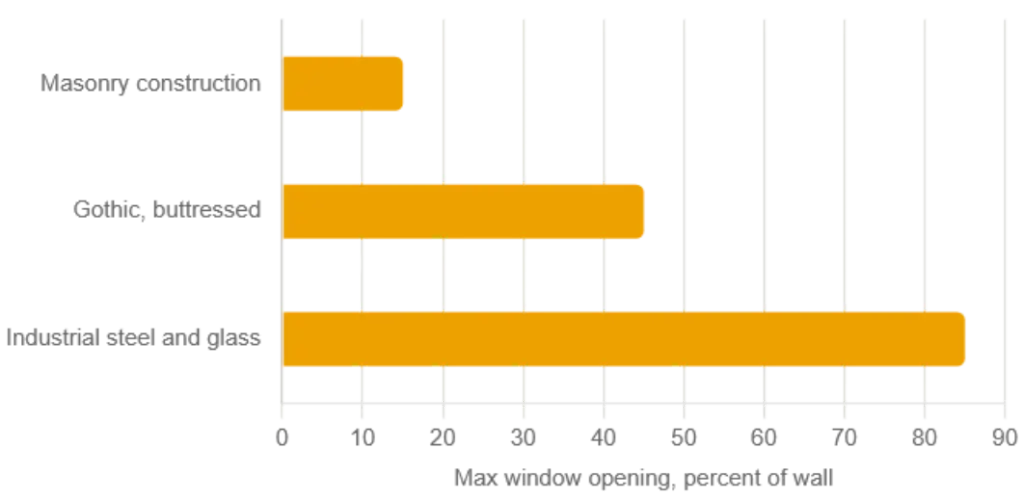
The Industrial Revolution introduced genuinely new physical capabilities into the history of lighting, driven by advances in glass manufacturing and high-strength structural materials that had simply not existed in earlier centuries. Where Roman builders had already developed glassmaking sophisticated enough to enable larger window openings and more elaborate glazing than their predecessors, industrial-era technology went considerably further, producing glass sheets large enough and steel structures strong enough to open entire facades to daylight in ways earlier load-bearing masonry construction could never have supported.
That expanded capability introduced new problems alongside its obvious benefits. Larger openings meant considerably more glare and thermal gain than earlier, more modest windows had ever produced, forcing architects to develop increasingly sophisticated shading strategies to manage the very abundance of light their new materials had made possible. This tension, between wanting more daylight and needing to control its less welcome side effects, marks a genuine turning point in the history of lighting: for the first time, the central challenge shifted from finding ways to let enough light in, toward finding ways to filter and moderate light that had become almost too abundant to manage comfortably.
6. Electric Light and the End of Daylight’s Monopoly

For virtually the entire span of the history of lighting up to this point, daylight supplemented by burned fuels, oil lamps, candles, and eventually gaslight, remained the only meaningful source of illumination available to architects. The arrival of practical electric lighting in the late nineteenth century ended that monopoly permanently, giving architects a source of illumination that no longer depended on the sun’s position, the weather, or the time of day. For the first time, a building’s interior brightness became something architects could specify and control with precision rather than something they could only filter, redirect, or wait for.
That shift did not make daylight obsolete so much as it changed its role within the larger design conversation, turning it from architecture’s only available light source into one option among several. Twentieth-century architects like Louis Kahn continued treating daylight as a genuinely primary material even after electric light became widely available, exemplified by his 1972 Kimbell Art Museum, designed with lighting consultant Richard Kelly, whose perforated aluminum ceiling reflectors distributed indirect sunlight evenly across the gallery spaces while protecting the artwork from direct exposure.
That project, alongside Kelly’s collaboration with engineer Isaac Goodbar on one of the earliest uses of computer technology in lighting design, marks a genuine bridge point in the history of lighting between daylighting’s ancient traditions and the computational tools that would follow.
7. Computational Lighting Design and Where the Field Stands Today

The most recent chapter in the history of lighting is defined by the same computational modeling that has transformed architectural acoustics over the same period. Contemporary lighting designers now simulate exactly how a proposed window configuration, shading device, or reflector geometry will distribute daylight through a space before a single wall is built, extending directly from the pioneering computer-assisted reflector calculations Richard Kelly’s team developed decades earlier at the Kimbell Art Museum.
That computational capability lets architects balance daylight’s genuine circadian and psychological benefits against glare, heat gain, and energy performance with a level of precision entirely unavailable to the builders of the Pantheon or Sainte-Chapelle.
Even as tools have grown dramatically more sophisticated, the underlying question animating the history of lighting has remained remarkably constant: how does a specific opening, in a specific wall, deliver a specific quality of light to the people occupying the space beneath it. Ancient Roman engineers answered that question with a single oculus cut into solid concrete. Gothic builders answered it by dissolving the wall into colored glass. Today’s architects answer it with parametric daylight simulation and tunable electric systems, but the fundamental design problem, of admitting exactly the right light in exactly the right place, has never actually changed.
Key Facts: History of Lighting at a Glance
| Era | Development |
|---|---|
| Ancient and medieval eras | Daylight treated as scarce, symbolic resource |
| c. 126 CE | Pantheon oculus completed under Hadrian |
| 12th century | Abbot Suger’s lux nova at Saint-Denis begins Gothic light tradition |
| High Gothic era | Sainte-Chapelle reduces wall to a frame for stained glass |
| Renaissance to Baroque | Light reoriented toward clarity, proportion, and drama |
| Industrial Revolution | Larger glass and steel openings, new glare and heat challenges |
| Late 19th century | Practical electric lighting ends daylight’s monopoly |
| 1972 | Kimbell Art Museum, early computer-assisted reflector design |
| 21st century | Parametric daylight simulation and tunable electric systems |
Frequently Asked Questions About the History of Lighting
What is the history of lighting in architecture?
The history of lighting traces how architects moved from treating daylight as a scarce, symbolic resource in ancient and medieval buildings to engineering it precisely through structures like the Pantheon’s oculus and Gothic stained glass, and eventually supplementing it with electric illumination and computational daylight simulation.
Why is the Pantheon’s oculus significant in the history of lighting?
The Pantheon’s oculus, completed around 126 CE, is significant in the history of lighting because it concentrated daylight into a single dramatic opening rather than distributing it through multiple windows, creating a dynamic beam of light that sweeps across the interior as the sun moves, a technique still studied by architects today.
How did Gothic architecture change the history of lighting?
Gothic architecture marked a major turning point in the history of lighting by treating stained glass as sacred, following Abbot Suger’s concept of lux nova at Saint-Denis. Structural innovations like flying buttresses let builders replace solid walls with expansive colored glass, as seen at Sainte-Chapelle in Paris.
When did electric lighting change architecture?
Electric lighting became practical in the late nineteenth century, marking a major shift in the history of lighting by giving architects a source of illumination independent of the sun, weather, and time of day for the first time, though architects like Louis Kahn continued treating daylight as a primary design material well into the twentieth century.
What role did the Industrial Revolution play in the history of lighting?
The Industrial Revolution introduced advances in glass manufacturing and structural steel that allowed much larger window openings than earlier masonry construction supported, a major development in the history of lighting that also introduced new challenges around glare and thermal gain that architects had to learn to manage.
How is computational design used in the history of lighting today?
Computational daylight simulation represents the most recent chapter in the history of lighting, letting architects model how window placement, shading, and reflector geometry will distribute light through a space before construction, building directly on early computer-assisted lighting work like Richard Kelly’s reflector design for the Kimbell Art Museum.
Related Posts from Architecture Associate
- History of Acoustics: 7 Bold Turning Points
- Light in Architecture: 7 Bold Ways We Perceive It
- Sound in Architecture: 7 Bold Ways We Perceive It
- Google Bay View Campus: 7 Bold Facts on Its Design
Explore more architecture theory and design science content in the Architecture category on Architecture Associate.
External References
- Architect Magazine, Daylighting History: architectmagazine.com
- D5 Mag, A Walk Through the History of Light in Architecture: d5mag.com
- Northern Architecture, History of Artificial Lighting: northernarchitecture.us
Final Thoughts
The history of lighting is ultimately the story of a single, unchanging resource, daylight, being reinterpreted again and again as culture, technology, and philosophy evolved around it. Roman engineers turned it into a single dramatic beam at the Pantheon. Gothic builders dissolved entire walls to let it pour through colored glass. Renaissance architects redirected it toward clarity and proportion, while the Industrial Revolution and electric lighting eventually freed architecture from depending on it at all.
Yet even now, with parametric simulation tools ancient builders could never have imagined, architects are still solving the exact same problem Hadrian’s engineers solved at the Pantheon nearly two thousand years ago: how to admit precisely the right light into precisely the right place.