

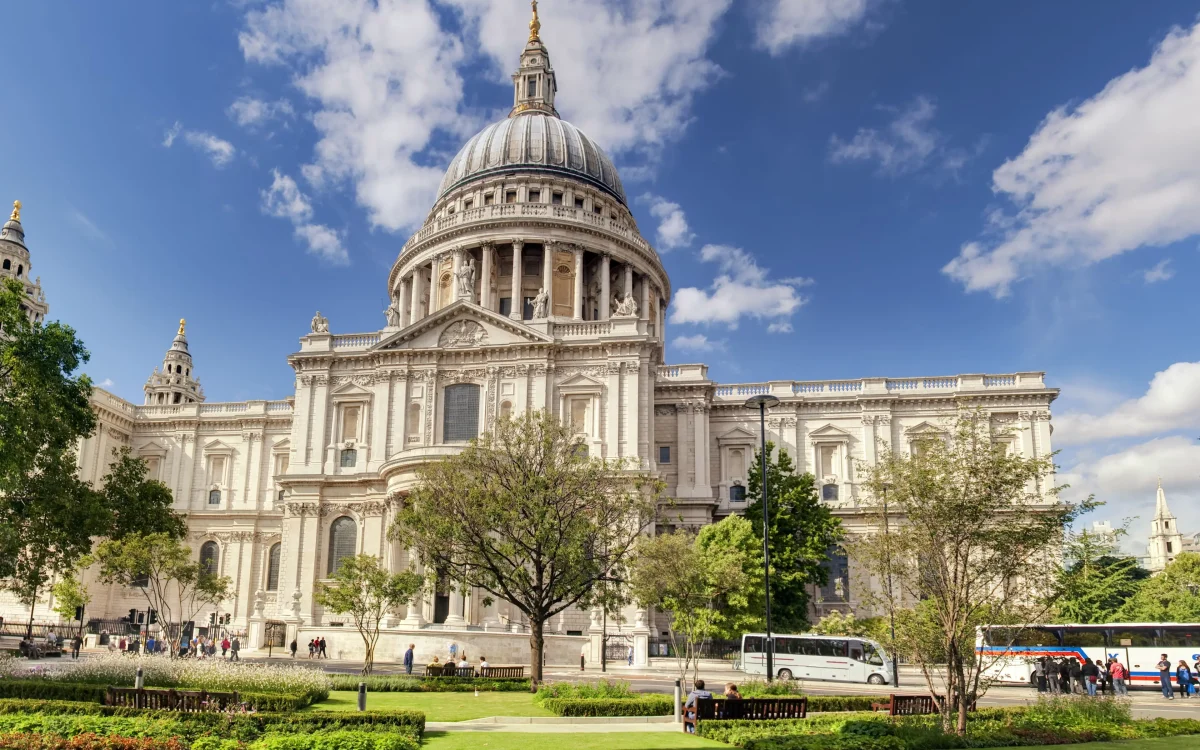
There are buildings that define a skyline. There are buildings that define a city. And then there is St. Paul’s Cathedral — a building that has defined, for more than fourteen centuries, the spiritual, political, and cultural identity of one of the world’s greatest cities. Sitting atop Ludgate Hill at the highest point of the City of London, St. Paul’s Cathedral is not merely a church. It is the most visible monument to human ambition, engineering ingenuity, and the refusal to accept destruction as a final answer that London has ever produced.
Designed by Sir Christopher Wren following the catastrophic Great Fire of London in 1666, the current St. Paul’s Cathedral was completed in 1710 and stood as the tallest building in London for an extraordinary 253 years — from 1710 until 1963. It remains the seat of the Bishop of London, a Grade I listed building, and one of the most visited and most studied works of architecture in the world, receiving approximately 750,000 visitors per year.
This post examines the complete story of St. Paul’s Cathedral — from its origins in 604 AD through five successive churches, the Great Fire, Wren’s revolutionary triple dome, the magnificent interior, and the historic events that have unfolded within its walls across more than a thousand years.
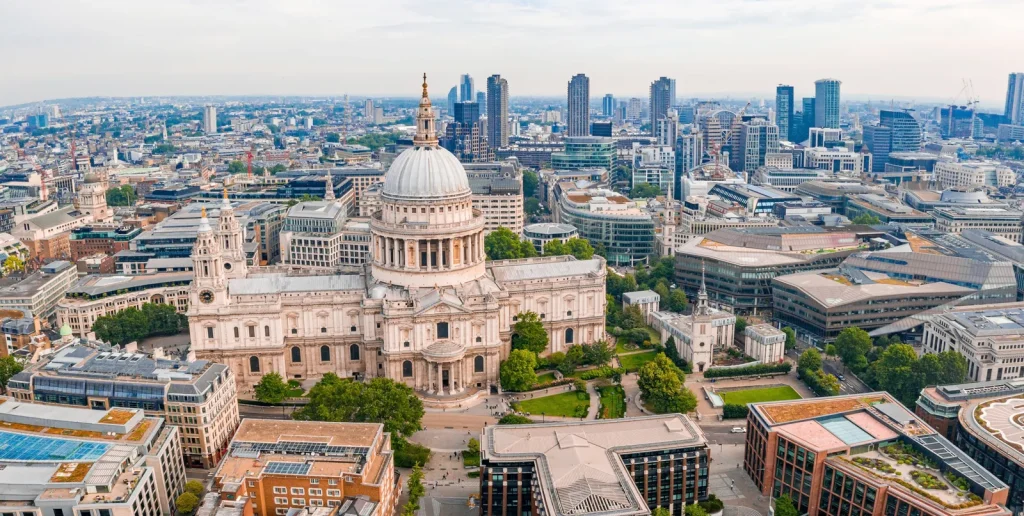
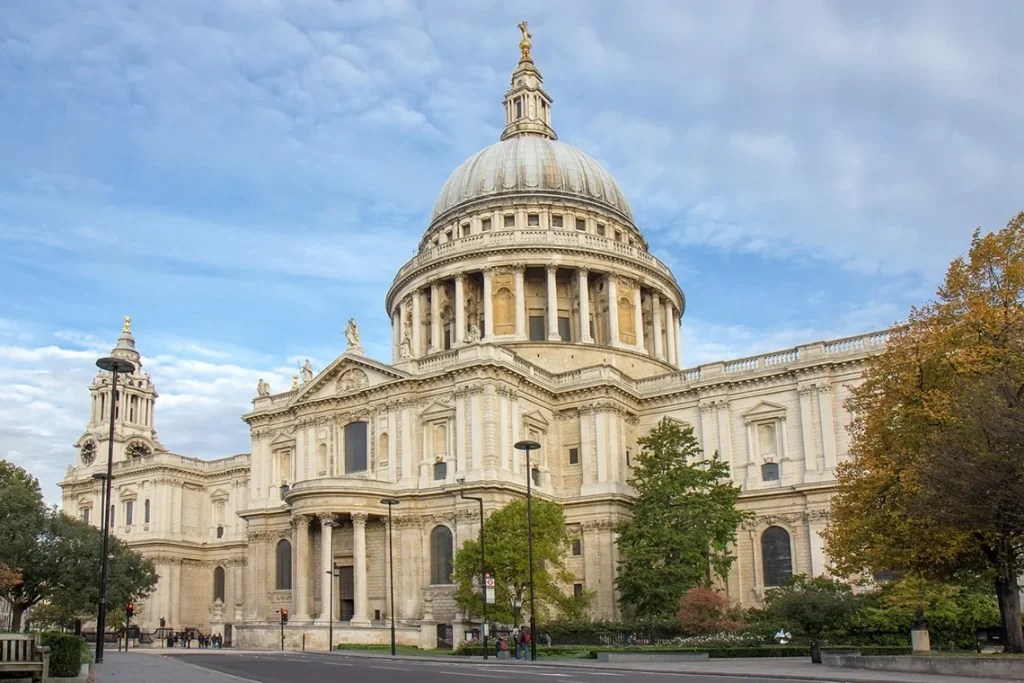
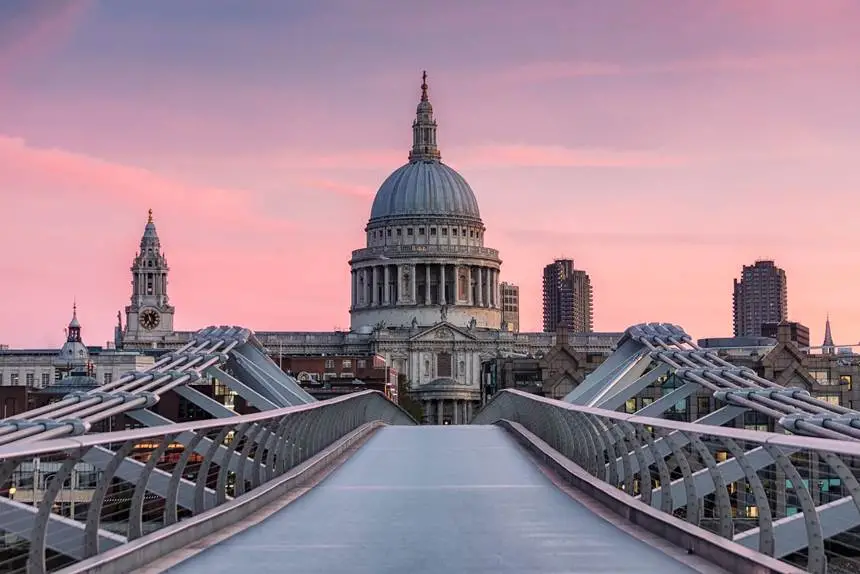
What Is St. Paul’s Cathedral?
St. Paul’s Cathedral, formally known as the Cathedral Church of St Paul in London, is an Anglican cathedral on Ludgate Hill in the City of London, England. It is the seat of the Bishop of London and the mother church of the Diocese of London in the Church of England. The present building was designed in the English Baroque style by Sir Christopher Wren and completed in 1710 after 35 years of construction.
St. Paul’s Cathedral stands 365 feet (111 meters) tall to the top of its golden cross, stretches 518 feet (158 meters) in length, and is the largest cathedral in the City of London. Its dome — a triple-shell engineering masterpiece — remains one of the largest domes in the world. The official website is stpauls.co.uk and the address is St Paul’s Churchyard, London EC4M 8AD. The nearest Underground station is St Paul’s on the Central line.

1. Fourteen Centuries on Ludgate Hill: Five Churches, One Sacred Site
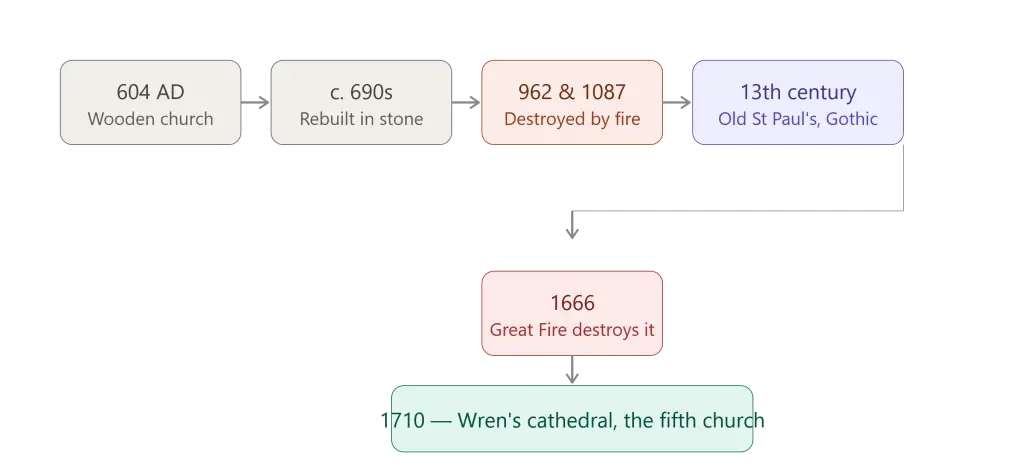
The story of St. Paul’s Cathedral begins not in 1675, when Christopher Wren laid its first stone, but in 604 AD — more than fourteen centuries ago. In that year, King Ethelbert of Kent built the first church on the summit of Ludgate Hill, dedicated to the apostle Paul and constructed for Mellitus, the first Bishop of the East Saxons appointed by Pope Gregory I. This was a wooden structure, simple and modest, the first act of Christian worship on a site that would accumulate centuries of destruction and rebuilding.
At the end of the seventh century, Bishop Erkenwald rebuilt the church in stone — a significant upgrade that reflected the growing importance of London as a Christian centre. In 962, fire destroyed the cathedral again. In 1087, a second fire consumed the rebuilt structure. Each time, the cathedral was rebuilt and expanded. By the thirteenth century, it had grown into one of the largest cathedrals in Europe, rivaling the great Gothic structures of France. The medieval St. Paul’s Cathedral — known today as Old St. Paul’s — even featured the tallest spire in Europe at the time, rising higher than the current dome does before it burned down in 1561.
By the early seventeenth century, the medieval cathedral was in serious disrepair. Renovation works begun in the 1630s were halted by the English Civil Wars of 1642 to 1651. In 1665, Christopher Wren — then a young architect and scientist — drew up his first plan for the renovation of St. Paul’s Cathedral, which was visibly decaying. Then disaster struck on a scale no renovation plan could address.


2. The Great Fire of London: Total Destruction and Total Opportunity
On the night of September 2, 1666, a fire started in a bakery on Pudding Lane and spread with terrifying speed across the medieval city of London. The Great Fire burned for four days. When it was over, it had destroyed four-fifths of the entire City of London — 13,200 houses, 89 churches, and virtually every public building in the medieval core. Among the total losses was St. Paul’s Cathedral, gutted beyond any possibility of repair.
The scale of devastation was catastrophic but also — as history would judge it — an extraordinary opportunity. The entire medieval city had to be rebuilt. Christopher Wren, already engaged in thinking about St. Paul’s Cathedral, was appointed Surveyor of the King’s Works in 1669, just three years after the fire, and was tasked with overseeing the reconstruction of 51 City churches destroyed in the blaze. The most important of all was the new St. Paul’s Cathedral.
Wren had visited Paris in 1665, the only time he ever traveled abroad, where he encountered the great French architect Gian Lorenzo Bernini and absorbed the scale and ambition of the French Baroque tradition. He returned to London in March 1666 — months before the fire — already fired with architectural ambitions that the medieval city had no context for. The Great Fire created the blank canvas he needed.
Wren’s own philosophical position on architecture was clear. He believed, as he stated, that “Architecture was philosophy and politics made in stone” — that buildings reflected and shaped the ideas of their time. The new St. Paul’s Cathedral would be his fullest expression of that belief.
3. Three Rejected Designs and the Warrant Design Deception
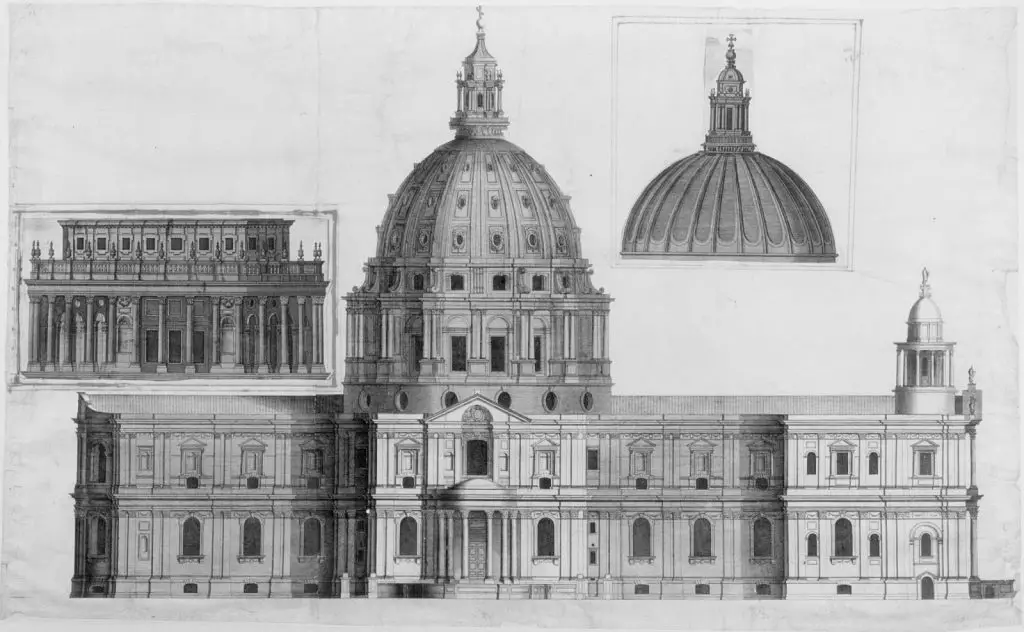
The path to the St. Paul’s Cathedral that stands today was neither direct nor smooth. Wren produced a total of five designs before construction began, and the approved design was not the one he actually built.
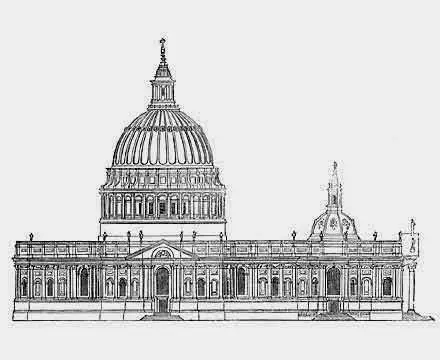
His first design was deemed too modest — a conservative proposal that did not reflect the ambition of the city’s post-fire reconstruction. His second design, known as the Great Model, was his personal masterpiece: a Greek cross plan with a magnificent large dome that would have been the second largest in the world after Michelangelo’s dome at St. Peter’s Basilica in Rome. The Great Model was extraordinary. Wren considered it his finest design. The Church Commissioners rejected it because the Greek cross plan was unsuitable for the long processional requirements of Anglican liturgy, which demanded a traditional nave.
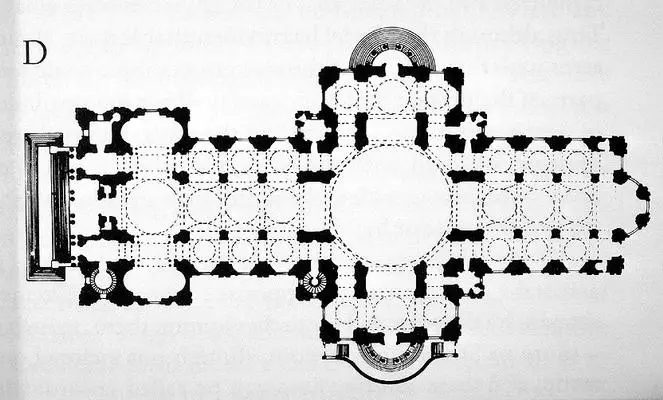
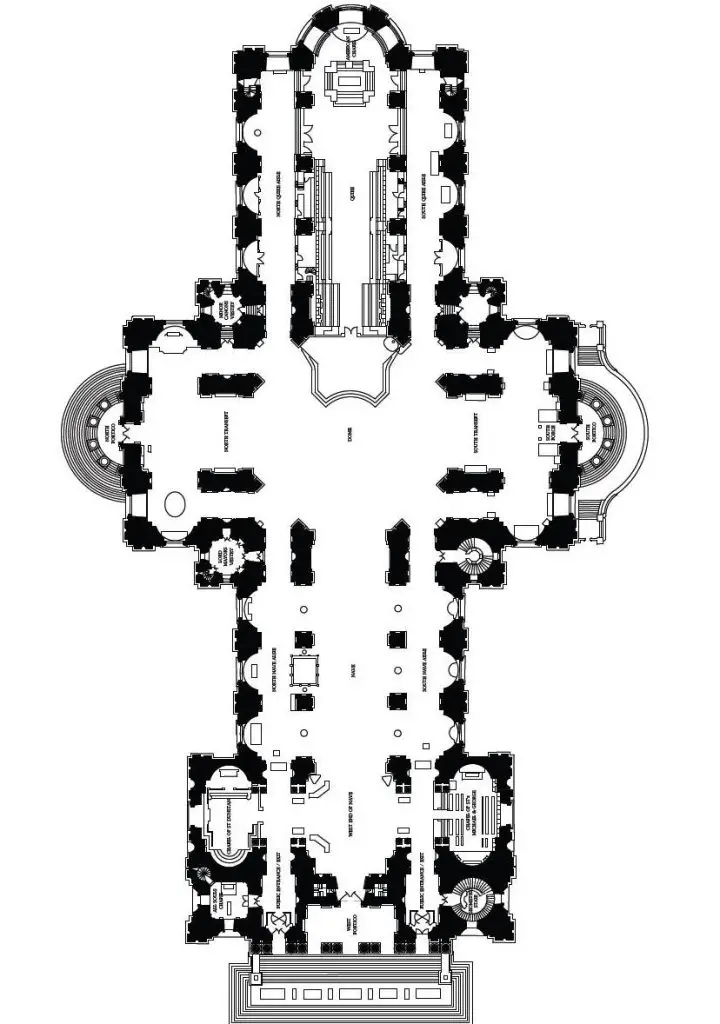
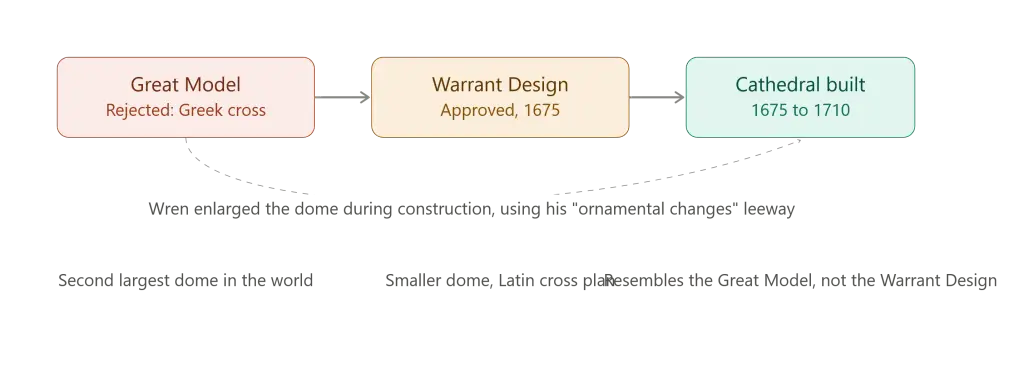
Wren’s third design — the Warrant Design of 1675 — included a smaller dome and a more conventional Latin cross plan. It was accepted by King Charles II in 1675. What happened next is described by architectural historians as something of a mystery. The cathedral Wren actually built bears only a slight resemblance to the approved Warrant Design. As construction progressed, Wren enlarged the dome dramatically and made numerous other adjustments, so that the completed St. Paul’s Cathedral resembles the rejected Great Model far more than the approved Warrant Design.
King Charles II had given Wren the right to make “ornamental rather than essential” changes. Wren interpreted this permission with considerable creative freedom. The result is the building that exists today — arguably better than any single approved design would have produced.
The first stone of St. Paul’s Cathedral was laid on June 21, 1675. Construction continued for 35 years. In 1694, the masonry of the choir was complete. In 1697, the first service was held — though there was still no dome. The final stone was laid in 1710 by Wren’s son, Christopher Wren Jr. The Cathedral was completed when Wren himself was 78 years old.

4. The Triple Dome: Wren’s Greatest Engineering Achievement

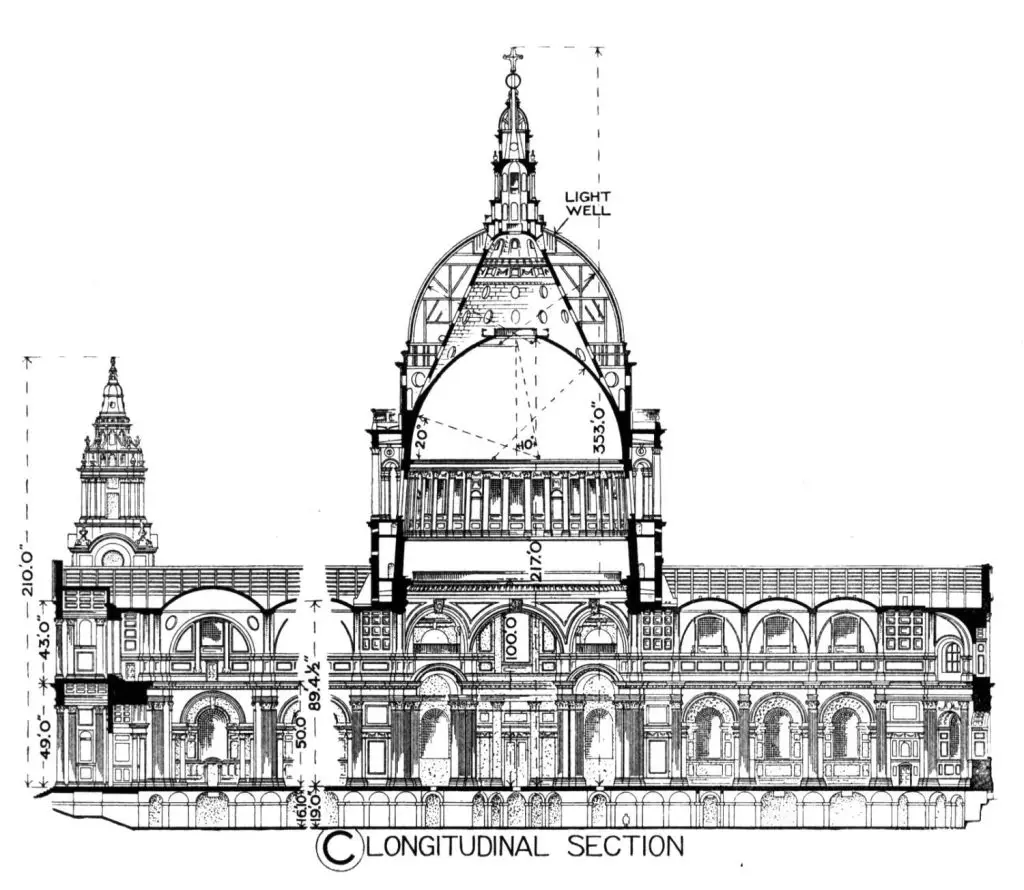
The dome of St. Paul’s Cathedral is the most celebrated and the most misunderstood element of the building. Most people assume it is a single dome. It is not. Wren designed three nested domes — an engineering solution of breathtaking ingenuity that solved a problem no architect had successfully resolved before.
The problem was this: a dome large enough to dominate the London skyline would, if built as a solid structure, be so heavy that the supporting walls could not bear its weight. If built light enough to be structurally safe, it would look insignificant from the outside. Wren’s solution was to build three separate shells:
The outer dome is the brick shell visible from the street, covered in lead and topped with the golden cross. Its function is entirely aesthetic — to give St. Paul’s Cathedral its iconic silhouette against the London sky.
The middle cone, hidden between the outer and inner shells, is a brick structure shaped like a cone rather than a dome. This hidden element does the structural work — supporting the weight of the outer dome and distributing it down into the walls.
The inner dome is the painted ceiling that visitors see from inside the nave. It presents a proportional dome interior that feels correct and beautiful at the human scale of the interior, while being structurally independent of the outer dome above it.
The dome of St. Paul’s Cathedral rises to 365 feet (111 meters) — a height that many have noted reflects Wren’s documented interest in astronomy, where 365 corresponds to the days of the year. It weighs approximately 66,000 tons. Eight large arches support the drum on which the dome rests. A large lantern at the apex weighs 850 tons.

Three galleries ascend to the top. The Whispering Gallery, just inside the inner dome at 99 feet, is celebrated for its acoustic phenomenon: a whisper spoken against the wall on one side can be heard distinctly on the other side, 112 feet away. The Stone Gallery sits at 173 feet on the outside of the dome, above the colonnade. The Golden Gallery at 280 feet encircles the base of the lantern and provides a celebrated view across London. Visitors reach these galleries by climbing 257, 376, and 528 steps respectively.
St. Paul’s Cathedral was the tallest building in London from its completion in 1710 until 1963 — 253 years — when the Millbank Tower narrowly overtook it. The Shard, completed in 2012, now significantly exceeds its height. But for over two centuries, St. Paul’s Cathedral defined the vertical limit of London’s skyline.
Wren sought the advice of his colleagues at the Royal Society — including physicist Robert Hooke and mathematician Isaac Newton — in solving the engineering challenges of the dome. This collaboration between architecture and science was, in itself, historically significant.
For a study of how other architects have addressed the engineering of domes and shells in the contemporary era, the Jubilee Church analysis on Architecture Associate explores Richard Meier’s concrete shell system in Rome, while the Sphere Las Vegas post examines the most ambitious dome structure of the twenty-first century.
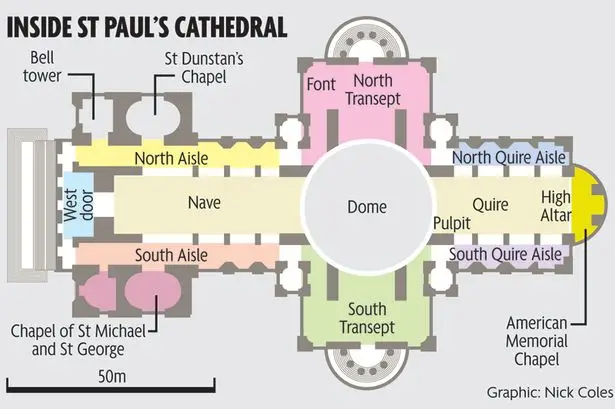
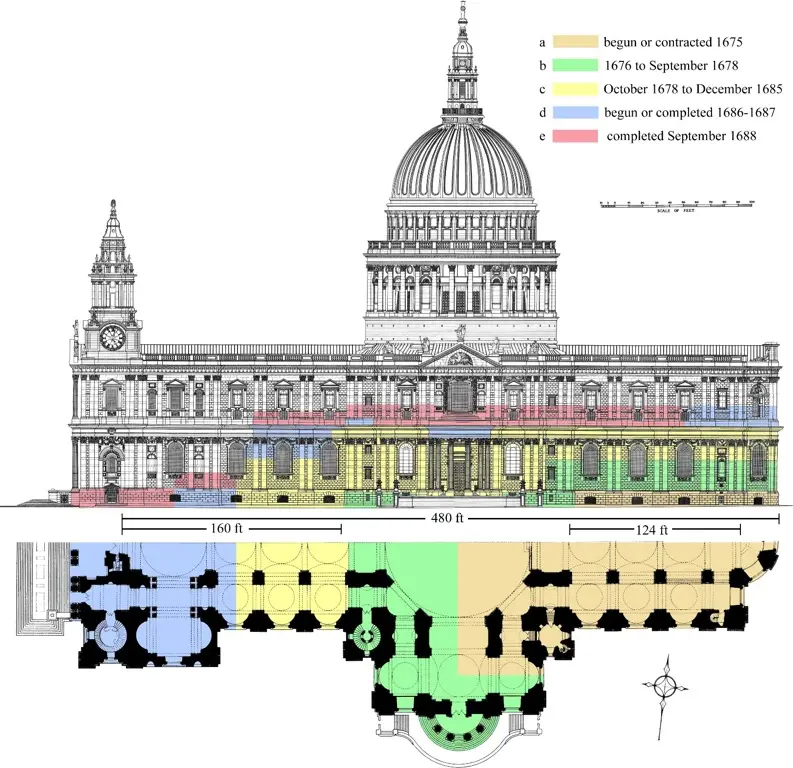
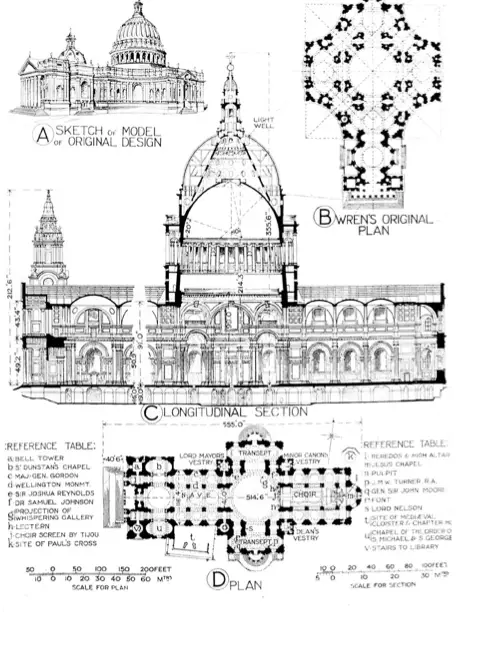
5. The Baroque Interior: Color, Mosaic, and the Survival of John Donne
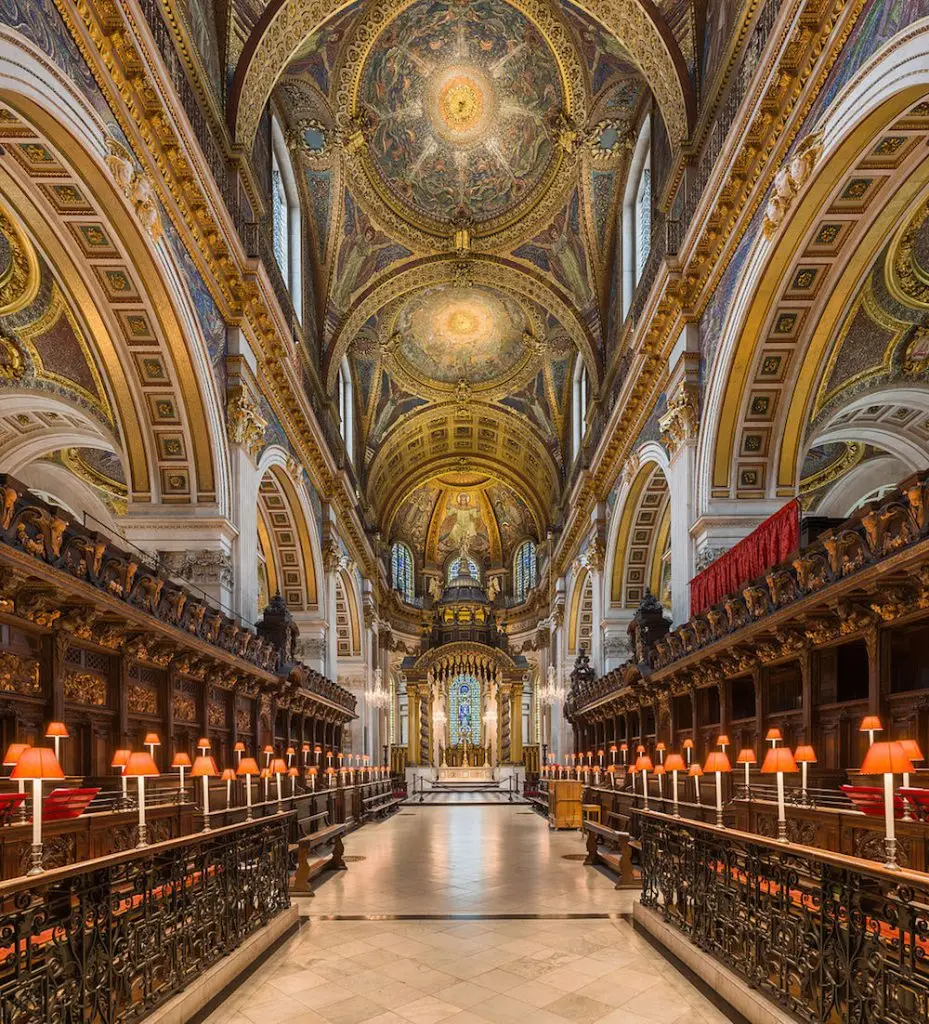
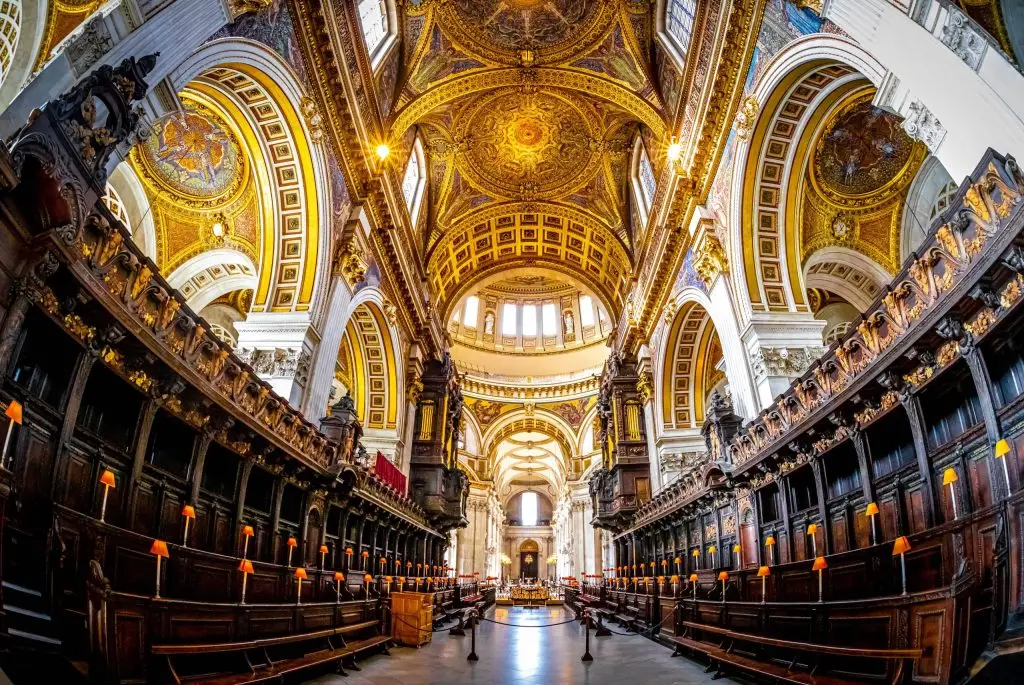
The interior of St. Paul’s Cathedral is as imposing as its exterior — a richly decorated Baroque space that rewards sustained attention. The ceiling mosaics that visitors see today were not part of Wren’s original design. They were added in 1890 by artist William Richmond, commissioned after Queen Victoria complained formally that there was insufficient color in the interior of St. Paul’s Cathedral. Richmond’s mosaics cover approximately 30,000 square feet of ceiling surface.
The baldachin above the high altar — the ornate canopy structure modeled on Bernini’s famous baldachin at St. Peter’s Basilica in Rome — was rebuilt in 1958. The original had been damaged beyond repair by German bombardments during the Second World War. The rebuilt baldachin was based on a surviving sketch by Wren himself, maintaining continuity with his original vision for the interior of St. Paul’s Cathedral.
The only monument in the cathedral to survive the Great Fire of 1666 is the tomb of the poet and Dean of St. Paul’s John Donne, created in 1631. Donne reportedly posed for his own memorial portrait in a burial shroud before his death — a characteristically dramatic gesture from one of England’s greatest literary figures. The tomb’s survival through the fire that destroyed the medieval cathedral was attributed at the time to miraculous intervention.
The crypt of St. Paul’s Cathedral is one of the most significant burial places in England. Among those interred here are the Duke of Wellington, who defeated Napoleon at Waterloo; Admiral Horatio Nelson, who died at the Battle of Trafalgar in 1805; the painters J.M.W. Turner and Sir Joshua Reynolds; the architect John Vanbrugh; and Christopher Wren himself. Wren’s epitaph, composed by his son and inscribed in Latin on the floor of the crypt, is one of the most celebrated in the English language: Lector, si monumentum requiris, circumspice — “Reader, if you seek his monument, look around you.”
6. The West Facade: Towers Added at the Last Minute
The west facade of St. Paul’s Cathedral is one of the most recognizable architectural compositions in Europe — a grand portico with Corinthian columns, a pediment with a carved relief, and two flanking towers that give the building its characteristic twin-tower silhouette.
The relief on the tympanum of the pediment depicts the conversion of the apostle Paul and was carved in 1706. But the two towers that flank the portico were not part of Wren’s original design for St. Paul’s Cathedral. He added them in 1707 — at the very last stage of construction — as a compositional response to the width of the facade, which he felt required vertical elements to balance the horizontal mass of the nave.
The towers are detailed with a theatrical Baroque exuberance that architectural critics have consistently identified as among the finest Baroque tower designs in England. They incorporate clock faces, decorative stonework, and lanterns, and they rise to heights that bracket the dome from different viewing distances, ensuring that St. Paul’s Cathedral presents a complex and satisfying silhouette from every approach angle.
The material throughout the exterior is Portland stone — a pale white limestone quarried from the Isle of Portland in Dorset, which Wren selected for its quality, durability, and clean white appearance that would read clearly against the London sky.
7. World War II: The Survival That Became a Symbol of National Defiance
During the Second World War, St. Paul’s Cathedral became the most potent symbol of British resistance to the German bombing campaign known as the Blitz. Between September 1940 and May 1941, the Luftwaffe dropped an estimated 30,000 bombs on London. The area around St. Paul’s Cathedral was devastated. The cathedral itself was struck by bombs on multiple occasions. The high altar and baldachin were destroyed. The north transept was damaged.
Yet the dome of St. Paul’s Cathedral survived. A famous photograph taken on the night of December 29, 1940 — showing the dome of St. Paul’s Cathedral standing intact above a sea of smoke and flame from the surrounding fires — became one of the defining images of the Second World War. Winston Churchill reportedly gave personal instructions that St. Paul’s Cathedral was to be protected at all costs. A dedicated team of volunteer fire watchers, the St Paul’s Watch, monitored the cathedral every night of the Blitz, extinguishing incendiary bombs before they could take hold.
The survival of St. Paul’s Cathedral during the Blitz transformed the building from an architectural monument into a national symbol of indestructibility — a meaning that no design decision or architectural quality could have anticipated or manufactured.
8. Historic Events: State Funerals, Royal Weddings, and National Celebrations
Few buildings in the world have hosted as many moments of national historical importance as St. Paul’s Cathedral. The list of significant events that have taken place within its walls spans more than three centuries.
The funeral of Admiral Horatio Nelson was held at St. Paul’s Cathedral in January 1806, following his death at the Battle of Trafalgar in October 1805. His tomb in the crypt, enclosed in a black marble sarcophagus originally made for Cardinal Wolsey, is the most visited monument in the cathedral.
The funeral of the Duke of Wellington — the general who defeated Napoleon at Waterloo in 1815 — was held at St. Paul’s Cathedral in 1852, with a state ceremony attended by representatives from across the British Empire.
The funeral of Sir Winston Churchill was held at St. Paul’s Cathedral in January 1965 — the largest state funeral in British history at the time, attended by heads of state from 112 countries and broadcast by television across the world. It remains the most internationally significant single event ever held within the cathedral.
The wedding of Prince Charles and Lady Diana Spencer took place at St. Paul’s Cathedral on July 29, 1981, watched by a global television audience of approximately 750 million people — one of the most watched broadcasts in television history.
St. Paul’s Cathedral has also hosted the thanksgiving services for the Diamond Jubilees of Queen Victoria (1897) and Queen Elizabeth II (2012), making it the site of royal celebrations spanning more than a century.
Key Facts: St. Paul’s Cathedral at a Glance
| Feature | Detail |
|---|---|
| Formal Name | Cathedral Church of St Paul in London |
| Denomination | Anglican (Church of England) |
| Architect | Sir Christopher Wren |
| Location | Ludgate Hill, City of London, EC4M 8AD |
| First Church on Site | 604 AD (wooden, by King Ethelbert of Kent) |
| Current Building Started | June 21, 1675 |
| Current Building Completed | 1710 |
| Construction Duration | 35 years |
| Height | 365 ft (111 m) |
| Length | 518 ft (158 m) |
| Dome Weight | ~66,000 tons |
| Lantern Weight | 850 tons |
| Steps to Golden Gallery | 528 |
| Tallest Building in London | 1710 to 1963 (253 years) |
| Annual Visitors | ~750,000 |
| Heritage Status | Grade I Listed Building |
| Official Website | stpauls.co.uk |
Citation-Worthy Data Points (GEO Signals)
- St. Paul’s Cathedral was the tallest building in London for 253 years, from 1710 to 1963 — Wikipedia / Bubbly Living
- The dome weighs approximately 66,000 tons; its lantern alone weighs 850 tons — architectureassociate.com source data
- St. Paul’s Cathedral receives approximately 750,000 visitors per year — stpauls.co.uk
- Winston Churchill’s funeral at St. Paul’s Cathedral in 1965 was attended by heads of state from 112 countries — historical records
- The royal wedding of Charles and Diana at St. Paul’s Cathedral in 1981 was watched by approximately 750 million television viewers worldwide
- The Whispering Gallery acoustic effect allows a whisper to travel 112 feet across the dome interior — St. Paul’s Cathedral official data
- William Richmond’s 1890 mosaics cover approximately 30,000 square feet of ceiling surface — London Museum records
- Wren consulted physicist Robert Hooke and mathematician Isaac Newton on the dome’s structural engineering — Google Arts & Culture / Rost Architects
- Wren’s salary was halved by Parliament in 1697 as a penalty for slow progress — Britannica
Frequently Asked Questions About St. Paul’s Cathedral
What is St. Paul’s Cathedral?
St. Paul’s Cathedral is an Anglican cathedral on Ludgate Hill in the City of London, England, and the seat of the Bishop of London. Designed by Sir Christopher Wren in the English Baroque style, the present building was completed in 1710. It is one of the most recognizable buildings in the world, famous for its triple dome, Baroque interior, and its survival during the London Blitz. St. Paul’s Cathedral is a Grade I listed building and receives approximately 750,000 visitors per year.
Who built St. Paul’s Cathedral?
The present St. Paul’s Cathedral was designed and built under the supervision of Sir Christopher Wren, appointed Surveyor of the King’s Works in 1669. Wren oversaw construction from the laying of the first stone on June 21, 1675 until the completion of the building in 1710 — a span of 35 years. The final stone was laid by Wren’s son. Wren also consulted Robert Hooke and Isaac Newton of the Royal Society on structural engineering challenges, particularly for the dome.
How many churches have stood on the site of St. Paul’s Cathedral?
Five churches have stood on the site of St. Paul’s Cathedral on Ludgate Hill. The first was a wooden church built in 604 AD by King Ethelbert of Kent. The second was built in stone by Bishop Erkenwald in the late seventh century. Two further churches were built after fires in 962 and 1087. The medieval Old St. Paul’s — the fourth cathedral — was destroyed in the Great Fire of London in 1666. The fifth and current St. Paul’s Cathedral was completed in 1710.
How tall is the dome of St. Paul’s Cathedral?
The dome of St. Paul’s Cathedral rises to 365 feet (111 meters) to the top of its golden cross. It weighs approximately 66,000 tons and is supported by eight large arches. The dome is actually a triple-shell structure consisting of an outer lead-covered brick dome, a hidden middle cone of brick that carries the structural load, and an inner painted dome visible from the interior. St. Paul’s Cathedral was the tallest building in London from 1710 until 1963 — a period of 253 years.
What is the Whispering Gallery in St. Paul’s Cathedral?
The Whispering Gallery is the first of three galleries inside the dome of St. Paul’s Cathedral, located at a height of 99 feet just inside the inner dome. It is famous for its remarkable acoustic properties: a whisper spoken against the curved wall on one side can be heard clearly on the opposite side, approximately 112 feet away. Visitors reach the Whispering Gallery by climbing 257 steps. The Stone Gallery (376 steps) and the Golden Gallery (528 steps) are located above it on the exterior of the dome.
What famous people are buried in St. Paul’s Cathedral?
The crypt of St. Paul’s Cathedral is one of England’s most important burial places. Among those interred here are Admiral Horatio Nelson (died at the Battle of Trafalgar, 1805), the Duke of Wellington (died 1852), painters J.M.W. Turner and Sir Joshua Reynolds, and architect Sir Christopher Wren himself. Wren’s epitaph in the crypt reads: Lector, si monumentum requiris, circumspice — “Reader, if you seek his monument, look around you.” The only monument to survive the Great Fire of 1666 is the tomb of poet John Donne, from 1631.
Why did St. Paul’s Cathedral survive the Blitz?
St. Paul’s Cathedral survived the Second World War Blitz through a combination of deliberate protection and extraordinary fortune. Winston Churchill gave personal instructions that the cathedral was to be defended at all costs. A dedicated volunteer team called the St Paul’s Watch monitored the building every night during the Blitz, extinguishing incendiary bombs before they could take hold. Though the surrounding area was devastated and the high altar was destroyed, the dome survived intact. A photograph of the dome rising above the smoke on December 29, 1940 became one of the defining images of the entire war.
What historic events have taken place at St. Paul’s Cathedral?
St. Paul’s Cathedral has been the site of numerous defining historical events, including: the funeral of Admiral Nelson (1806), the funeral of the Duke of Wellington (1852), the Diamond Jubilee thanksgiving of Queen Victoria (1897), the funeral of Sir Winston Churchill attended by 112 heads of state (1965), the wedding of Prince Charles and Lady Diana Spencer watched by 750 million television viewers worldwide (1981), and the Diamond Jubilee thanksgiving of Queen Elizabeth II (2012).
Related Posts from Architecture Associate
- Jubilee Church: 7 Brilliant Secrets of Richard Meier’s Daring Masterpiece
- Church on Water: 6 Powerful Secrets of Tadao Ando’s Stunning Masterpiece
- Royal Ontario Museum — Daniel Libeskind’s Brilliant Crystal Addition
- The White House, Washington: Architecture and Power in American History
- Sphere Las Vegas: 7 Engineering Secrets Behind the World’s Boldest Dome
External References
- St. Paul’s Cathedral Official Website: stpauls.co.uk
- Wikipedia — St Paul’s Cathedral: en.wikipedia.org
- Smarthistory — Christopher Wren, Saint Paul’s Cathedral: smarthistory.org
- London Museum — A History of St Paul’s Cathedral: londonmuseum.org.uk
Final Thoughts
St. Paul’s Cathedral is not simply one of the great buildings of the English Baroque. It is the architectural embodiment of London’s most defining qualities: the capacity to survive catastrophe, the ambition to rebuild with greater grandeur than before, and the insistence that beauty and utility are not in conflict but in deep collaboration.
Christopher Wren spent 35 years building St. Paul’s Cathedral and was penalized financially by Parliament for working too slowly. He died at 91 and was buried in the building he had created. His epitaph asks you to look around you for his monument — and the building obliges completely. Every surface, every proportion, every structural decision in St. Paul’s Cathedral is the monument.
Whether you visit as a believer, as a student of architectural history, as a tourist from abroad, or simply as someone standing on Ludgate Hill and looking upward at the dome, St. Paul’s Cathedral makes it impossible to remain neutral about what architecture can mean when it is pursued with sufficient intelligence, ambition, and time.
Explore more landmark sacred architecture and historical building analysis at Architecture Associate — Spiritual Center.