

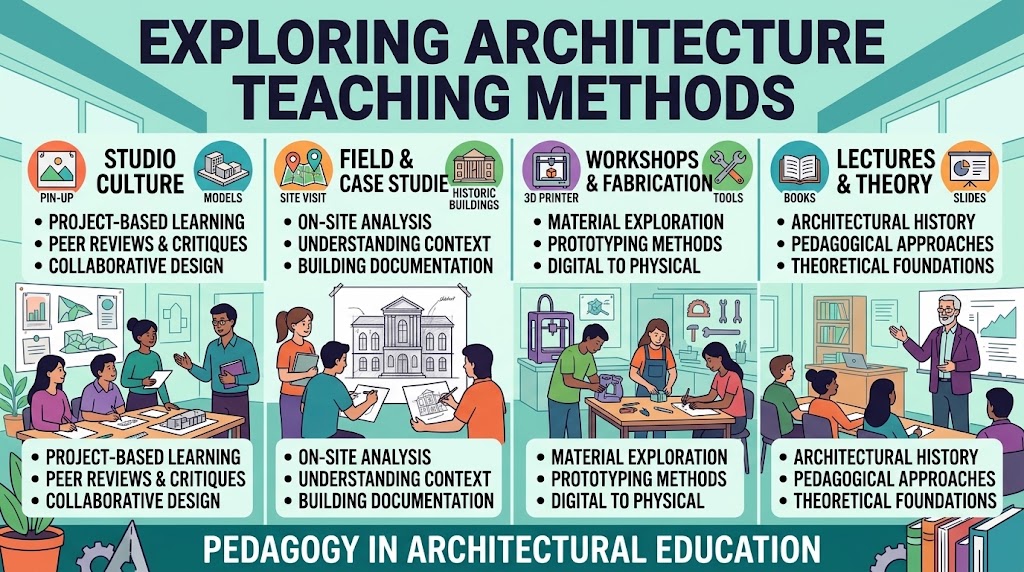
Architects are teachers by default. The moment an architect explains a design decision to a client, they are already teaching.
The same happens when they walk a contractor through a detail, or mentor a junior draftsman on site. Architecture teaching is happening constantly, whether the architect realizes it or not.
The real question is not whether architects can teach. It is whether they teach well.
A good architect does not automatically become a good architecture teacher. That transition takes specific techniques, a working method, and patience.
It also takes a willingness to treat teaching as a craft in its own right. Too often it gets bolted onto a design career as an afterthought.
This guide breaks down what effective architecture teaching actually looks like in 2026. It covers university studios, professional mentorship programs, and everyday practice, since architecture teaching happens in all three places at once.
Below are seven proven, field-tested approaches. You can start using them immediately.
Why Architecture Teaching Deserves More Respect Than It Gets
Unlike school teachers, most people who take on architecture teaching roles never studied pedagogy formally. They are practicing architects first.
They stepped into a studio, a lecture hall, or a mentorship role because someone needed to fill it. Sometimes it is simply because they loved the discipline enough to want to pass it on.
This is both the strength and the weakness of architecture teaching as it exists today.
The strength is credibility. Architecture teaching delivered by working architects carries real-world weight, because students are not learning theory divorced from practice.
They are learning from someone who has stood on a construction site arguing with a contractor about a beam depth. That kind of lived experience cannot be faked in a lecture slide.
The weakness is structure. Without formal pedagogical training, many talented architects default to teaching the way they were taught.
That often means intimidating critiques, vague feedback, and a “figure it out yourself” studio culture. The result leaves students anxious rather than inspired.
Good architecture teaching bridges that gap. It keeps the authenticity of practice-based knowledge intact.
At the same time, it borrows proven techniques from education science. Scaffolding, formative feedback, active learning, and reflective practice all help that knowledge actually land.

What Makes Architecture Teaching Different From Other Subjects
Architecture teaching sits at an unusual crossroads. It is part technical instruction, covering structures, materials, and codes.
It is also part creative coaching, covering form, concept, and spatial reasoning. And it is part professional mentorship, covering client communication, project management, and ethics.
Few other disciplines ask a teacher to move fluidly between a physics lesson and an open-ended conversation about beauty. Architecture teaching demands both, often in the same hour.
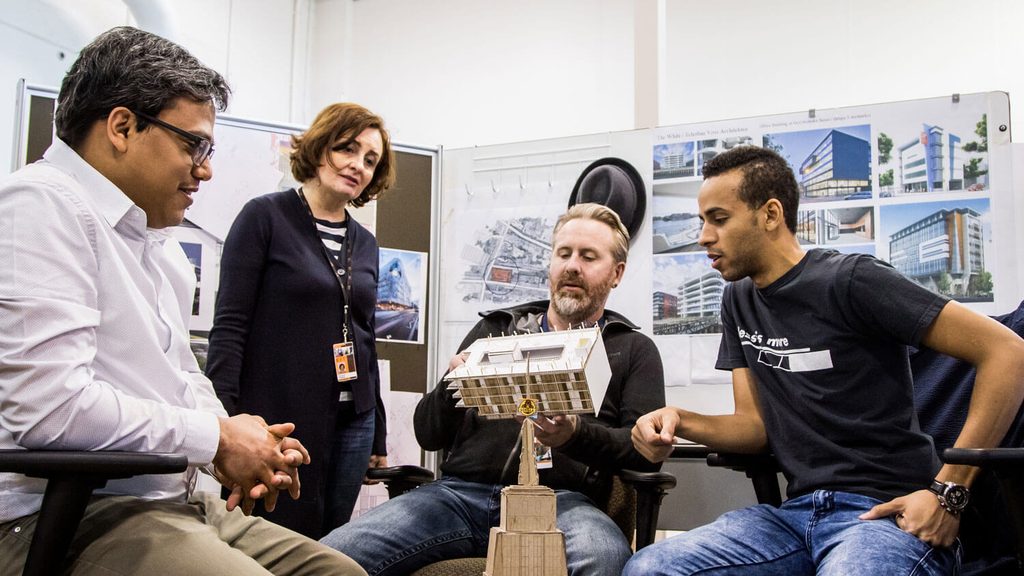
This is why the design studio remains the beating heart of architecture teaching. Unlike a lecture hall, the studio is built around one-on-one desk critiques.
Peer review and iterative model-making round out the format. Students are rarely just listening; they are constantly producing and defending work.
This studio format forces students to defend ideas out loud. It also forces them to revise those ideas under real pressure.
Over time, this builds internalized feedback through repetition, not memorization. Research into studio pedagogy points to this cycle of critique, revision, and re-critique as the real engine of design intuition.

1. Start With Structured Critique, Not Just Opinion
The desk crit and the final jury review are the two pillars of architecture teaching. Both are frequently misused.
A critique that consists only of “I like this” or “this doesn’t work” teaches a student almost nothing. It gives them no reasoning to internalize and reuse on the next project.
Effective critique structures itself around three questions every time. What was the student trying to achieve?
Does the current solution actually achieve it? And what specific, actionable change would move it closer?
This turns a subjective opinion into a repeatable thinking process. The student can apply it independently once the teacher is no longer standing over their shoulder.
That independence is, after all, the actual goal of teaching. A teacher who is still needed at every step has not finished the job.
Some studios have moved toward group reviews instead. Multiple instructors weigh in on a single project together, rather than pairing one tutor permanently with one student.
This model has been tested in several schools. It reduces the risk of a single teacher’s blind spots shaping a student’s entire design language.
It also exposes students to a wider range of architecture teaching styles in one sitting. That variety tends to produce more adaptable young designers.

2. Teach the Process, Not Just the Product
A common trap is grading only the final rendering or the final model. This quietly tells students that the process leading up to it does not matter.
In reality, the sketches, the failed iterations, and the pinup boards full of rejected options are where most of the actual learning happens. The polished final image is just the residue of that process.
Strong studio teaching makes the process visible and assessable. Ask students to keep a working logbook of decisions and dead ends.
Require them to present at least one abandoned direction alongside their final proposal. Have them explain clearly why it was dropped.
This single habit does more for design maturity than any number of polished final crits. It trains students to interrogate their own thinking, rather than simply produce a pleasing image.
Over a semester, this shifts the entire studio culture. Students start treating failed ideas as data, not embarrassment.

3. Use Real Constraints, Not Hypothetical Ones
Relying purely on open-ended, hypothetical briefs carries a hidden risk. It can produce graduates who design beautifully but freeze the moment a real client enters the room.
The same happens with a real budget or a real building code. Comfort with ambiguity does not automatically translate into comfort with constraint.
Introducing genuine constraints early and often closes this gap. Actual site conditions, actual structural limits, and actual accessibility codes all count.
This is one of the most reliable ways to connect academic training with real-world readiness. Students who wrestle with real limits in school adapt faster once they start practicing.
This does not mean studio teaching should abandon conceptual exploration entirely. It means pairing imagination with friction, not removing imagination altogether.
A studio brief that asks students to design a community library on a real, awkward urban site teaches far more resilience. Add a real budget ceiling, and the lesson becomes even sharper than any unconstrained “design a library” prompt ever could.

4. Make Feedback a Two-Way Conversation
One of the most overlooked shifts in modern design education is treating feedback as a dialogue. Too often it is still delivered as a verdict handed down from above.
Asking students to explain their own reasoning first changes the dynamic completely. Only after that should the instructor offer a view.
This does two things at once. It reveals the actual thought process behind a decision, rather than just the visible outcome.
It also signals that the student’s intent is respected, even when the execution still needs work. That respect matters more than most critique formats acknowledge.
This approach mirrors a broader shift in education research. Teaching is moving away from a strict apprenticeship model toward a relationship between collaborating peers.
A studio culture that stays purely hierarchical tends to produce compliant students, not confident designers. The teacher pronounces judgment, and the student simply absorbs it in silence.
Inviting respectful pushback produces something different. It produces architects who can defend their decisions in front of a client, a planning board, or a hostile budget committee.
5. Blend Digital Tools Without Losing Hand-Thinking
Modern design education cannot ignore parametric software, BIM, and AI-assisted rendering tools. All three are now standard fixtures of professional practice.
But there is still strong pedagogical value in requiring hand sketching early in a design process. Physical model-making belongs in that same early stage.
These slower methods force a level of spatial reasoning that a mouse click can quietly skip over. Software often lets students bypass hard spatial decisions before they have actually made them.
The best studio practice today treats digital tools as an extension of thinking. They get introduced once a concept has already been tested by hand.
That sequencing matters more than it sounds. Students who sketch a section before modeling it in software tend to make more confident decisions later, because they have already worked through the spatial logic once.
6. Build in Reflective Practice
A studio that only ever looks forward to the next deadline rarely gives students room to consolidate learning. Everything blurs together across a fast-moving semester.
Building short reflective exercises into the studio calendar helps counter this. A one-page written reflection after every major review is often enough.
These short exercises help students articulate what actually changed in their thinking. That is different from simply noting what changed in their drawings.
This habit pays off well beyond school walls. Architects who continue reflective practice into professional life tend to develop a stronger, more consistent design voice over time.
They are actively tracking their own growth, rather than letting each project blur into the next. Installing this habit early hands students a tool they will use for an entire career.
7. Remember That Confidence Is Part of the Curriculum
Design skill and design confidence are not the same thing. Studio culture too often assumes that the first will automatically produce the second.
Many capable students leave a harsh crit convinced they lack talent. What they actually lack is a structured way of receiving criticism without internalizing it as a judgment of their worth.
Good studio teaching separates the work from the person delivering feedback about it. That separation has to be intentional; it rarely happens by accident.
Language matters here more than most instructors realize. “This plan doesn’t resolve the circulation problem” lands very differently than “this doesn’t work,” even though both point to the same flaw.
Teachers who make this distinction consistently see a real effect. Students take more creative risks, because failure in the studio stops feeling catastrophic.
Instead, it starts feeling like a normal, expected part of design. That shift alone can transform a struggling studio culture.
How Architecture Teaching Is Evolving in 2026
Architecture schools worldwide are actively rethinking their teaching pedagogy. The direction of travel is fairly consistent across programs.
There is less rigid hierarchy and more collaborative review formats. Sustainability, accessibility, and real-world site constraints are becoming core parts of the curriculum, not optional add-ons.
Extended reality tools are also being piloted in several programs. They let students walk through unbuilt designs at full scale before construction begins.
This adds an entirely new dimension to how spatial critique happens. A design flaw that is invisible on a screen can become obvious the moment a student stands inside it virtually.
At the same time, there is a renewed push to formalize studio teaching itself as a skill worth training. Several universities now run dedicated seminars for this exact purpose.
These seminars cover syllabus design, feedback delivery, and studio management. They no longer assume that design talent automatically transfers into teaching ability.
This shift acknowledges what studio culture has quietly known for decades: teaching design is its own discipline, deserving the same rigor architects bring to a building.
Practical Checklist for Architects Stepping Into a Teaching Role
If you are an architect preparing to teach for the first time, a few habits make the transition smoother. This applies whether it is a university studio, a mentorship program, or informally guiding junior staff.
Set clear expectations about process documentation from day one. Students need to understand that sketches and failed attempts are part of what gets evaluated, not just the final board.
Structure every critique around three things. What the student intended, whether the work achieves it, and what one specific change would help.
Introduce real constraints early, rather than easing students into open-ended fantasy briefs. Comfort with ambiguity should be earned, not assumed.
Make time for reflection after major milestones. Resist the urge to rush straight to the next deadline without pausing first.
And separate criticism of the work from judgment of the person, every single time. That single habit protects a student’s confidence more than any amount of encouragement after the fact.
None of this requires a formal education degree. It requires treating the craft of teaching with the same intentionality that goes into a well-resolved building.
A clear brief, a considered process, and room to revise before anything is called final. That is the whole method, distilled.
Common Mistakes That Undermine Architecture Teaching
Even experienced instructors fall into avoidable habits that quietly weaken their teaching. Recognizing these patterns is often the fastest way to improve.
The first mistake is over-directing. Redesigning a student’s project during a crit, rather than guiding them toward their own solution, teaches dependency instead of judgment.
The second is inconsistency. Praising an idea one week and dismissing a similar idea the next week, without explaining why, leaves students unable to build a stable internal compass.
The third is neglecting weaker students. It is tempting to spend the most energy on the strongest projects in a studio, since they are the most rewarding to discuss.
But a studio that only invests in top performers leaves the rest of the class undertrained. Struggling students often need more structured guidance, not less attention.
The fourth mistake is treating silence as understanding. A student who nods during a crit has not necessarily absorbed anything.
Asking students to restate feedback in their own words closes this gap quickly. It also reveals misunderstandings before they get baked into the next iteration of the project.
Bringing It All Together
Teaching architecture well improves fastest when it is treated as a system, not a collection of isolated tips. Each of the seven approaches above reinforces the others.
Structured critique works best when paired with visible process documentation. Real constraints land harder when feedback is a genuine two-way conversation, not a lecture.
Reflective practice ties the whole cycle together, because it is where students actually notice their own growth. Confidence-protecting language makes every other technique easier to receive without defensiveness.
None of these seven approaches require expensive tools or institutional backing. They require intention, consistency, and a willingness to treat architecture teaching itself as a design problem worth solving carefully.
Related Content
- Villa Shodhan: How Le Corbusier Balanced Light, Privacy, and Climate
- Acoustics and Lighting in Architecture: Visual and Sonic Design
- Camp Meeker Cabin: 3 Sleeping Nooks, Zero Carbon
- Google Bay View Campus: 7 Bold Facts on Its Design
- Brooklyn Central Library Renovation: 5 Bold Phases
Frequently Asked Questions About Architecture Teaching
What qualifications does someone need for architecture teaching?
Most university-level architecture teaching positions require a professional architecture degree and often a master’s or doctoral qualification, along with practical design experience. Many programs also value active professional practice, since it keeps the teaching grounded in real-world conditions rather than purely academic theory.
Is a design studio the best format for architecture teaching?
The design studio remains the most effective format for architecture teaching because it combines individual critique, peer learning, and iterative revision in a single environment. Lecture-based formats work well for technical and historical content, but spatial and design reasoning are best developed through studio practice.
How can architects improve their architecture teaching skills without a formal education background?
Architects can strengthen their architecture teaching by studying basic feedback frameworks, observing experienced studio instructors, and deliberately structuring critiques around specific, actionable questions rather than general opinions. Some universities now offer dedicated pedagogy seminars specifically for practicing architects who want to teach.
Does architecture teaching need to change with new technology like AI and BIM?
Yes, architecture teaching increasingly incorporates digital tools such as BIM and AI-assisted design software, but most educators recommend introducing these tools after students have practiced hand sketching and physical modeling, so digital fluency builds on top of strong spatial reasoning rather than replacing it.
Final Thoughts
Architecture teaching is not a side effect of being a good architect; it is a separate skill that has to be practiced, refined, and taken seriously. The architects who teach well are not necessarily the most talented designers in the room — they are the ones who have learned how to structure feedback, protect a student’s confidence while still being honest about weak work, and make the invisible process of design thinking visible enough for someone else to learn from.
Whether you are stepping into a studio for the first time or mentoring a junior colleague at your firm, architecture teaching rewards the same care and iteration you would bring to any building: start with a clear intention, revise often, and never mistake the first draft for the final one.