

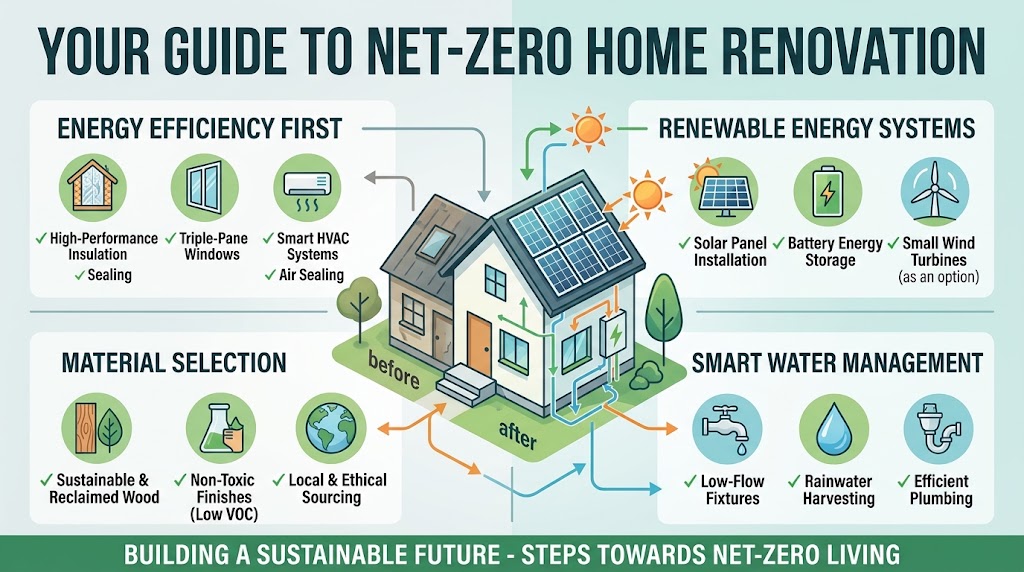
A net-zero home renovation aims for a genuinely specific target: reducing a home’s annual energy consumption low enough that on-site renewable generation, almost always rooftop solar, can offset it entirely over a full year. That target sounds simple, but the path to it runs through a sequence of expensive, interdependent decisions, insulation, air sealing, windows, heating and cooling equipment, and finally solar, each of which changes the cost and sizing of everything that comes after it. Getting that sequence wrong is the single most common way homeowners overspend on a net-zero retrofit without actually reaching net-zero performance.
The economics of a net-zero home renovation also shifted meaningfully heading into 2026. The federal Energy Efficient Home Improvement Credit and Residential Clean Energy Credit, which had covered 30 percent of qualifying insulation, heat pump, and solar costs since 2022, both ended for property placed in service after December 31, 2025, under P.L. 119-21. That change does not eliminate the financial case for a deep energy retrofit, but it does change the math considerably, shifting the conversation toward state and utility rebates, income-qualified programs, and the underlying value of avoided energy bills rather than a blanket federal tax credit.
This guide walks through the complete economics of a net-zero home renovation — what the full project typically costs, how those costs break down by system, what changed with the 2025 federal tax credit expiration, realistic payback periods for each major upgrade, how these projects affect resale value, and the sequencing strategy that determines whether the investment actually pays off.
What Is a Net-Zero Home Renovation?
A net-zero home renovation is a comprehensive energy retrofit of an existing home designed to bring annual energy consumption down to the point where on-site renewable generation, typically solar photovoltaic panels, can offset it over a full year. For an existing single-family home, this level of renovation typically ranges from roughly 100,000 to 200,000 dollars depending on the home’s age, size, climate zone, and existing condition, and generally includes high-performance insulation, air sealing to reduce infiltration, upgraded windows, a high-efficiency heat pump for heating and cooling, and a properly sized solar array.
Most net-zero renovations reach full payback within 10 to 15 years through eliminated or dramatically reduced utility bills, though individual components within the project pay back considerably faster or slower than that blended average.
1. What a Net-Zero Home Renovation Actually Costs
Total project cost for a net-zero home renovation varies enormously based on a home’s starting condition, but general contractors and energy modelers consistently point to a similar range for a full deep energy retrofit: roughly 100,000 to 200,000 dollars for an existing single-family home pursuing a genuine net-zero standard. That figure sits well above a conventional cosmetic renovation, where whole-house work typically runs 15 to 60 dollars per square foot, because a net-zero retrofit adds building envelope work, mechanical system replacement, and a solar array on top of whatever cosmetic scope a homeowner might otherwise plan.
New construction offers a useful cost comparison for understanding this premium. Real-world net-zero new-build costs in the Pacific Northwest run roughly 291 to 425 dollars per square foot before permitting, engineering, and design fees, while broader national data suggests the net-zero premium over a comparable conventional new home averages closer to 10 dollars per square foot, or roughly 5 to 15 percent of total project cost.
Renovating an existing home to net-zero standard generally costs more per square foot of improvement than building net-zero from scratch, since retrofitting insulation, air sealing, and mechanical systems into an existing structure is considerably more labor-intensive than integrating the same performance into new construction from day one.
2. Cost Breakdown by System
Understanding where the money in a net-zero home renovation actually goes helps homeowners prioritize a genuinely constrained budget. Building envelope work, insulation, air sealing, and window replacement, typically consumes the largest single share of project cost, since bringing wall insulation up to a high-performance standard and improving airtightness to below roughly 1.5 air changes per hour requires substantial labor throughout the home rather than a single equipment swap. Professional attic air sealing and insulation alone typically runs 2,500 to 6,000 dollars nationally, a relatively modest line item that nonetheless delivers one of the strongest returns of any component in the entire renovation.
Mechanical system replacement represents the next major cost category. A full high-efficiency heat pump system, sized to replace both heating and cooling equipment, typically costs 8,000 to 20,000 dollars nationally depending on home size and existing ductwork condition, while a heat pump water heater and electrical panel upgrade, often necessary to support the increased electrical load of heat pumps, EV charging, or induction cooking, add further cost on top of that.
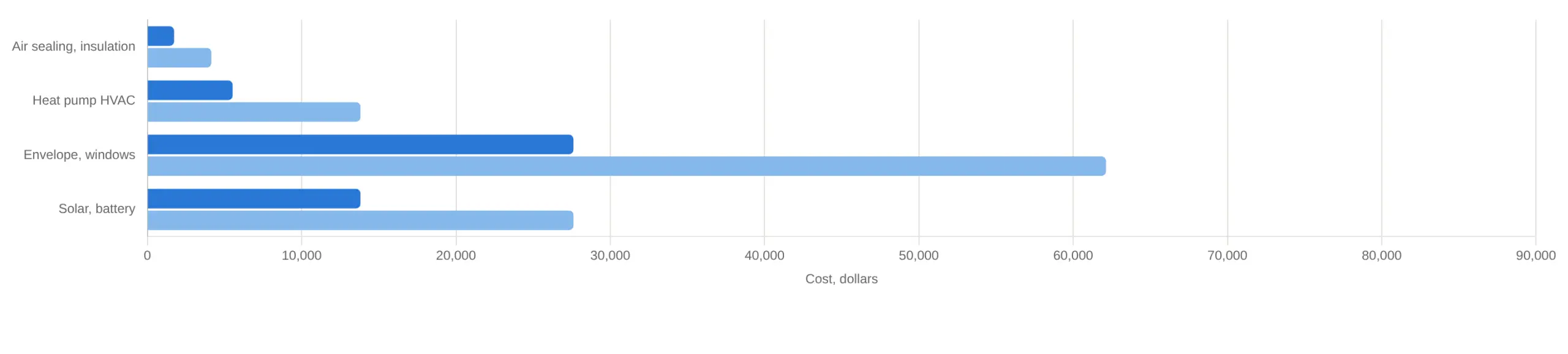
Solar and battery storage typically arrive last in both sequence and installed cost, since a well-executed envelope and mechanical upgrade reduces overall energy demand enough that the solar array required to reach net-zero can often be sized smaller, and therefore priced lower, than it would have been on an unimproved home.
3. The 2025 Federal Tax Credit Expiration and What Replaced It
No discussion of net-zero home renovation economics heading into 2026 is complete without addressing a genuinely significant policy change. The Energy Efficient Home Improvement Credit, known as Section 25C, and the Residential Clean Energy Credit, known as Section 25D, both created under the 2022 Inflation Reduction Act, covered 30 percent of qualifying costs for insulation, air sealing, windows, heat pumps, heat pump water heaters, electrical panels, and solar installations. Under P.L. 119-21, both credits ended for property placed in service after December 31, 2025, meaning homeowners comparing a 2025 contractor invoice to a 2026 quote for functionally identical work will find the federal tax credit that previously applied is simply no longer available.
That expiration does not mean all financial support for a net-zero home renovation has disappeared. State-administered, income-qualified rebate programs created under the same 2022 legislation, often referred to by the shorthand HEAR and HOMES, continue rolling out in many states independently of the expired tax credits, offering support including up to 8,000 dollars for heat pump HVAC systems, up to 4,000 dollars for electrical panel upgrades, and up to 1,750 dollars for heat pump water heaters for income-eligible households.
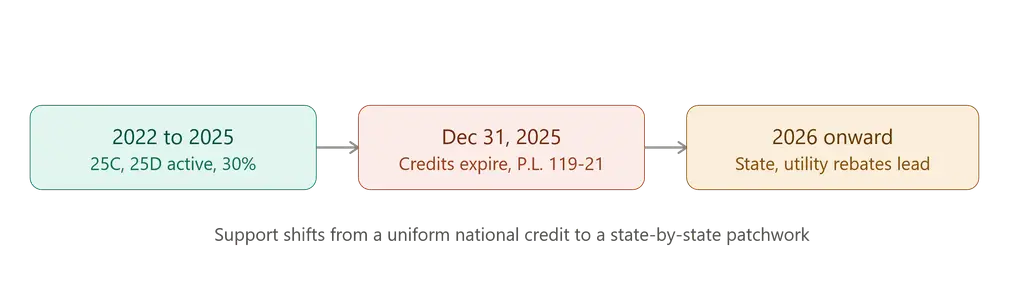
Beyond these federal-adjacent programs, many state energy offices and individual utilities maintain their own rebate programs for insulation, heat pumps, and solar, meaning the financial case for a net-zero home renovation now depends considerably more on a homeowner’s specific state and utility territory than it did when a uniform 30 percent federal credit applied nationwide.
This shift toward a patchwork of regional incentives makes early research a genuinely important part of budgeting any net-zero home renovation in 2026. A homeowner in a state with an active, well-funded HEAR rollout and a utility offering generous solar net metering may find the effective cost of a deep energy retrofit only modestly higher than it was in 2025, while a homeowner in a state with minimal remaining rebate infrastructure will feel the full weight of the expired federal credit directly.
Consulting a state energy office or a local utility’s efficiency program before finalizing a renovation budget, rather than assuming a blanket national figure applies, has become a genuinely necessary step in the planning process rather than an optional one.
4. Realistic Payback Periods by Upgrade
Because a full net-zero home renovation bundles many individual upgrades together, understanding the payback period of each component separately helps homeowners sequence spending sensibly rather than treating the whole project as a single undifferentiated expense. Air sealing and insulation consistently deliver the fastest and most reliable payback of any component, typically recovering their cost within three to seven years through reduced heating and cooling bills, a return that remains strong even without any tax credit support. Smart thermostats and LED lighting upgrades pay back even faster, often within one to three years, though their absolute dollar savings are modest compared to envelope and mechanical work.
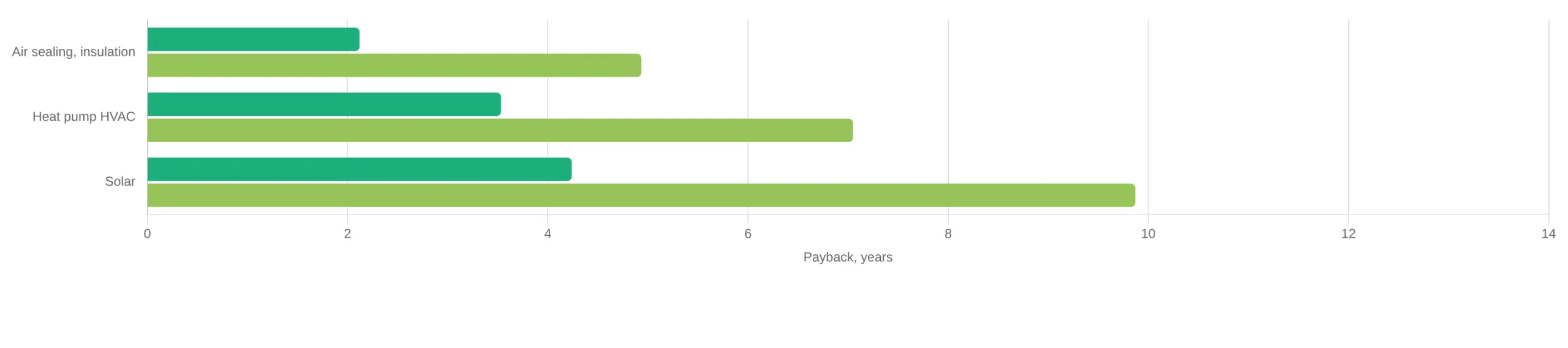
Heat pump HVAC systems typically pay back within five to ten years on installed cost alone, a timeline that lengthens somewhat now that the 30 percent federal credit has expired but remains reasonable given ongoing state and utility rebates plus reduced heating and cooling costs compared to older gas or electric resistance systems. Solar installations show the widest payback range of any major component, typically six to fourteen years depending heavily on a home’s roof orientation, local solar irradiance, electricity rates, and whether the local utility offers favorable net metering, a range that has shifted longer since the federal Residential Clean Energy Credit’s expiration removed a full 30 percent of typical solar project cost from the payback calculation.
5. Resale Value and Real Estate Impact
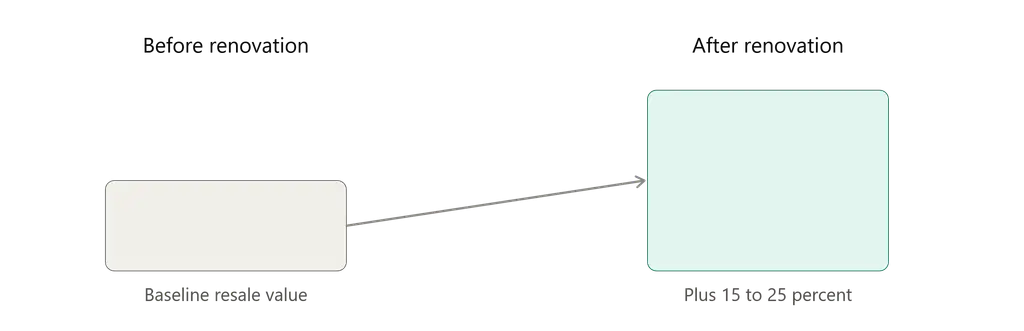
Beyond utility bill savings, a net-zero home renovation carries real implications for a property’s resale value. Market data from regions actively tracking net-zero retrofits shows resale value increases in the range of 15 to 25 percent for homes that complete a genuine deep energy retrofit, a premium buyers increasingly attribute to lower guaranteed operating costs and improved thermal comfort rather than purely to environmental values. That premium tends to be strongest in markets with volatile or rising utility rates, where a documented, verified low energy bill functions almost like a form of prepaid, predictable housing cost that buyers are willing to pay for directly.
Individual components within a broader net-zero home renovation also show measurably different resale returns when evaluated separately. Curb appeal and envelope-adjacent projects, including exterior work and high-efficiency mechanical replacements, have shown particularly strong resale returns in recent Cost vs. Value analysis, while purely cosmetic high-end finishes consistently underperform mid-range renovations at resale despite costing considerably more upfront. That pattern reinforces a broader lesson: buyers increasingly reward genuine performance upgrades, verified lower bills, documented efficiency ratings, over purely decorative spending, even within a single combined renovation budget.
6. Sequencing Strategy: Why Order Matters More Than Budget
The single most consequential decision in any net-zero home renovation is not how much money is available, but the order in which that money gets spent. Energy modelers and experienced retrofit contractors consistently recommend a fabric-first sequence: address air sealing and insulation first, since these are the cheapest improvements with the fastest payback and the largest effect on how much mechanical capacity the home will actually need. Only after the building envelope has been tightened should a homeowner move to mechanical system replacement, sizing a new heat pump to the home’s actual, now-reduced heating and cooling load rather than to its old, leaky baseline.

Solar belongs last in this sequence for a genuinely practical reason: installing a large solar array on a home that has not yet addressed its envelope and mechanical inefficiencies means paying to generate electricity that promptly leaks back out through poorly insulated walls and an oversized, inefficient HVAC system.
A net-zero home renovation that reverses this order, installing solar first because it is the most visible and exciting component, routinely ends up both more expensive and less effective than one that follows the fabric-first sequence, since the eventual envelope and mechanical work still has to happen, and by then the solar array may already be oversized or mis-sized for the home’s true, improved energy demand.
Key Facts: Net-Zero Home Renovation at a Glance
| Element | Detail |
| Typical full renovation cost (existing home) | 100,000 to 200,000 dollars |
| Net-zero premium, new construction | Roughly 5 to 15 percent, about 10 dollars per sq ft |
| Attic air sealing and insulation cost | 2,500 to 6,000 dollars |
| Full heat pump HVAC system cost | 8,000 to 20,000 dollars |
| Air sealing and insulation payback | 3 to 7 years |
| Heat pump HVAC payback | 5 to 10 years |
| Solar payback | 6 to 14 years |
| Federal 25C and 25D tax credits | Expired for property placed in service after Dec 31, 2025 |
| Remaining income-qualified rebates | Up to 8,000 dollars, heat pump HVAC (HEAR) |
| Resale value increase | Approximately 15 to 25 percent |
| Overall project payback | 10 to 15 years |
Frequently Asked Questions About Net-Zero Home Renovation
How much does a net-zero home renovation cost?
A net-zero home renovation for an existing single-family home typically costs between 100,000 and 200,000 dollars, covering high-performance insulation, air sealing, upgraded windows, a heat pump system, and a properly sized solar array, though the exact figure depends heavily on the home’s size, age, climate zone, and starting condition.
What is the payback period for a net-zero home renovation?
A full net-zero home renovation generally reaches payback within 10 to 15 years, though individual components pay back at different speeds, with air sealing and insulation typically recovering cost in 3 to 7 years, heat pump systems in 5 to 10 years, and solar in 6 to 14 years.
Are federal tax credits still available for net-zero home renovation in 2026?
The federal Energy Efficient Home Improvement Credit and Residential Clean Energy Credit, which previously covered 30 percent of qualifying costs for a net-zero home renovation, ended for property placed in service after December 31, 2025, under P.L. 119-21. State and utility rebates, along with income-qualified programs, remain available in many areas.
Does a net-zero home renovation increase resale value?
Yes. Markets actively tracking deep energy retrofits show resale value increases in the range of 15 to 25 percent for homes that complete a genuine net-zero home renovation, a premium driven largely by buyer demand for lower, more predictable utility costs.
What should be renovated first in a net-zero home renovation?
Energy modelers recommend a fabric-first sequence for any net-zero home renovation: address air sealing and insulation first, then replace mechanical systems sized to the improved building envelope, and install solar last so the array is sized correctly for the home’s actual, reduced energy demand.
Is a net-zero home renovation worth it without federal tax credits?
In most markets, yes, particularly for homeowners planning to stay in their home for seven or more years, since declining equipment costs and rising electricity rates continue to support reasonable payback periods even without the expired 30 percent federal credit, especially when combined with remaining state or utility rebates.
Related Posts from Architecture Associate
- Camp Meeker Cabin: 3 Sleeping Nooks, Zero Carbon
- Watertown Exploratory Labs WELL: 7 Bold Facts on Its Rebirth
- Google Bay View Campus: 7 Bold Facts on Its Design
- Basics of Light: 7 Bold Concepts Every Architect Needs
Explore more sustainable design and renovation case studies in the Architecture category on Architecture Associate.
External References
- Ask Doss, Best Energy Efficiency Upgrades 2026, Cost and Real Payback: askdoss.com
- Energy Rebate Calculator, Best Energy Efficient Home Improvements Ranked by ROI: energyrebatecalculator.com
- Reno Quotes, Net-Zero Renovation Cost, Rebates and ROI Guide: renoquotes.com
Final Thoughts
A net-zero home renovation is genuinely achievable on a realistic budget, but only when cost decisions follow a deliberate sequence rather than chasing the most visible upgrade first. Air sealing and insulation remain the highest-return investment available to almost any homeowner, heat pump systems deliver solid payback even without the federal credit that expired at the end of 2025, and solar, sized correctly after the envelope and mechanical work is complete, closes the gap to true net-zero performance.
The federal tax landscape shifted meaningfully heading into 2026, but the underlying economics, driven by rising electricity rates, improving equipment efficiency, and genuine resale value gains, still make a well-sequenced deep energy retrofit one of the more financially sound renovations a homeowner can undertake.